
Global Manual Vegetable Transplanter Market Introduction
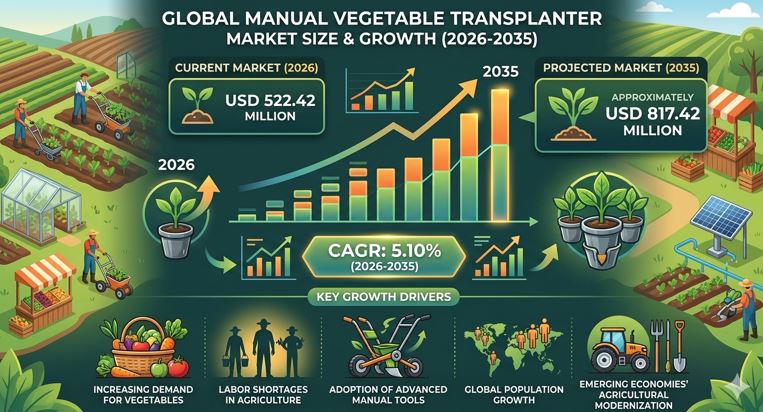
The global manual vegetable transplanter market size is predicted to increase from USD 522.42 million in 2026 to approximately USD 817.42 million by 2035, growing at a CAGR of 5.10% from 2026 to 2035.
The global manual vegetable transplanter market is witnessing steady growth due to the increasing demand for efficient, cost-effective, and labor-saving agricultural equipment. Manual vegetable transplanters are farming tools designed to assist in the transplantation of vegetable seedlings from nurseries into agricultural fields. These devices help farmers improve planting accuracy, reduce labor intensity, and increase operational efficiency, especially in small-scale and medium-scale farming operations. With the growing pressure on the agricultural sector to improve productivity and address labor shortages, manual vegetable transplanters have emerged as an important solution in modern vegetable cultivation practices.
Vegetable transplantation is a crucial process in farming because proper seedling placement directly affects crop growth, yield quality, and overall farm productivity. Traditionally, vegetable transplantation has been carried out manually, requiring significant labor and time. However, rising labor costs and the decreasing availability of agricultural workers in many regions have encouraged farmers to adopt manual transplanter equipment that simplifies and accelerates planting operations. These machines are particularly suitable for crops such as tomatoes, cabbage, chili peppers, lettuce, cauliflower, and brinjal, among others.
One of the major factors driving the growth of the manual vegetable transplanter market is the increasing focus on agricultural mechanization. Governments and agricultural organizations across the world are promoting the use of modern farming equipment to improve crop productivity and ensure food security. Small and marginal farmers, especially in developing economies, are increasingly adopting affordable and easy-to-operate manual transplanters as an alternative to expensive automated machinery. Manual vegetable transplanters are considered highly beneficial because they require minimal fuel or power consumption while still improving planting efficiency.
The growing global population and increasing demand for fresh vegetables are also contributing to market expansion. Rising awareness regarding healthy diets and nutritional food consumption has increased vegetable production worldwide. As vegetable farming expands, farmers are seeking practical tools that can support large-scale cultivation without significantly increasing labor dependency. Manual transplanters allow farmers to maintain consistent plant spacing and proper planting depth, leading to better crop uniformity and improved yields.
Technological advancements and product innovation are further shaping the market landscape. Manufacturers are developing lightweight, durable, and ergonomically designed manual transplanters that improve user comfort and operational performance. Some advanced models are equipped with adjustable row spacing, seedling trays, and multifunctional capabilities to support different crop varieties and soil conditions. These innovations are making manual vegetable transplanters more attractive to farmers looking for affordable mechanization solutions.
Key Manual Vegetable Transplanter Market Dynamics
The global manual vegetable transplanter market is influenced by several dynamic factors that determine its growth, demand, and long-term development. Market dynamics include drivers, restraints, opportunities, challenges, and emerging trends that shape the competitive landscape of the industry. The increasing need for agricultural efficiency, rising labor shortages, and growing vegetable production are among the primary factors contributing to the expansion of the manual vegetable transplanter market worldwide.
One of the key drivers of the market is the rising demand for agricultural mechanization. Farmers across both developed and developing regions are increasingly adopting farming equipment to improve productivity and reduce manual labor dependency. Traditional vegetable transplantation methods require significant physical effort and time, making them less efficient for modern farming practices. Manual vegetable transplanters help improve planting speed, maintain proper spacing between seedlings, and ensure uniform crop establishment. These advantages make them highly attractive to farmers seeking affordable mechanization solutions.
Labor shortages and rising agricultural wages are also major factors driving market growth. In many agricultural economies, rural labor migration toward urban areas has reduced the availability of farm workers. At the same time, increasing labor costs have raised the overall expenses associated with manual farming activities. Manual vegetable transplanters help reduce labor requirements while improving operational efficiency, making them a practical choice for small and medium-scale vegetable farmers.
Another important dynamic influencing the market is the growing global demand for vegetables and fresh produce. Rising population levels, changing dietary habits, and increasing awareness regarding healthy eating are encouraging higher vegetable consumption worldwide. To meet this growing demand, farmers are expanding vegetable cultivation and investing in efficient farming equipment. Manual vegetable transplanters support faster planting operations and improve crop consistency, which contributes to better productivity and higher-quality yields.
Government support and agricultural development programs are further strengthening the market. Many governments are promoting farm mechanization through subsidies, training programs, and financial assistance for agricultural equipment purchases. These initiatives are particularly important in developing countries where small-scale farmers may face financial limitations. By encouraging the use of affordable farming tools such as manual transplanters, governments aim to improve agricultural productivity, reduce labor dependency, and support food security goals.
Technological advancements are also shaping the market dynamics. Manufacturers are introducing lightweight, user-friendly, and durable transplanter models designed to improve operational efficiency and farmer comfort. Features such as adjustable planting depth, row spacing mechanisms, and ergonomic designs are enhancing product performance and increasing adoption rates. Product innovation is helping companies differentiate themselves in a competitive market while meeting the changing requirements of modern agriculture.
Despite positive growth prospects, the market also faces several restraints and challenges. Limited awareness regarding advanced agricultural tools in rural and underdeveloped regions can restrict market penetration. Many farmers continue to rely on traditional planting methods due to familiarity and lower upfront costs. In addition, some farmers may find manual transplanters expensive compared to conventional labor practices, especially in regions where labor costs remain relatively low.
The market also faces competition from semi-automatic and fully automatic vegetable transplanters. Large commercial farms often prefer automated equipment because of higher efficiency and reduced operational time. Manual transplanters may be less suitable for extensive farming operations or difficult soil conditions, which can limit their adoption in certain agricultural environments.
Overall, the global manual vegetable transplanter market is expected to experience steady growth due to increasing mechanization, rising labor challenges, and expanding vegetable cultivation activities. Supportive government policies, technological improvements, and growing awareness regarding efficient farming practices are likely to create favorable conditions for market expansion in the coming years.
Key Manual Vegetable Transplanter Market Restraints
The global manual vegetable transplanter market has shown promising growth due to increasing agricultural mechanization and the need for labor-saving farming tools. However, several restraints continue to limit the market’s full growth potential. These challenges are related to economic conditions, technological limitations, farmer awareness, operational constraints, and competition from advanced farming equipment. Understanding these restraints is important for manufacturers, policymakers, and agricultural stakeholders to develop effective strategies that support market expansion.
One of the major restraints affecting the manual vegetable transplanter market is the limited awareness among farmers, particularly in rural and underdeveloped regions. Many small-scale farmers still rely on traditional transplantation methods due to familiarity and lack of exposure to modern agricultural equipment. In several developing countries, farmers may not fully understand the benefits of manual vegetable transplanters, including improved planting efficiency, reduced labor requirements, and better crop uniformity. The absence of proper training programs and demonstration activities further slows product adoption in these regions.
Another significant challenge is the initial investment cost associated with manual vegetable transplanters. Although these machines are more affordable than fully automated transplanting equipment, they may still be considered expensive for small and marginal farmers with limited financial resources. In regions where access to agricultural credit and financing remains weak, many farmers hesitate to invest in farming machinery. As a result, they continue to depend on low-cost manual labor for transplantation activities, especially in labor-abundant economies.
The availability of inexpensive agricultural labor in some developing countries also acts as a restraint for market growth. In areas where labor costs remain relatively low, farmers may not see the immediate need to adopt mechanized transplanting tools. Traditional manual planting methods are often viewed as economically viable, particularly for small farms with limited cultivation areas. This reduces the urgency for farmers to transition toward mechanized transplantation practices.
Operational limitations of manual vegetable transplanters may also restrict their adoption. These machines are generally more suitable for small-scale and medium-scale farming operations and may not perform efficiently in large commercial farms. In addition, certain soil conditions, uneven terrains, and varying crop requirements can affect machine performance and planting accuracy. Some manual transplanters may require skilled handling or regular maintenance to ensure proper functionality, which can discourage adoption among farmers with limited technical knowledge.
Competition from semi-automatic and fully automatic transplanters is another major restraint in the market. As agricultural technology continues to advance, larger farms are increasingly investing in automated machinery capable of higher efficiency, faster planting operations, and reduced labor dependency. Fully automated transplanting systems offer advanced features such as precision planting, GPS integration, and multi-row operations, making them more attractive for commercial-scale farming. This technological competition may limit the market share of manual vegetable transplanters in highly mechanized agricultural regions.
Supply chain and distribution challenges can also hinder market growth. In remote agricultural areas, farmers may face difficulties accessing modern farming equipment due to inadequate dealer networks, transportation limitations, and poor infrastructure. The lack of after-sales services, spare parts availability, and technical support may further reduce farmer confidence in adopting manual transplanters.
Additionally, fluctuating agricultural incomes and unpredictable weather conditions can impact farmers’ purchasing decisions. Economic uncertainty, crop failures, and climate-related risks often force farmers to prioritize essential farming expenses rather than investing in new equipment. Seasonal demand patterns may also affect market stability and sales performance.
Manual Vegetable Transplanter Market Opportunities
The global manual vegetable transplanter market presents significant growth opportunities due to the increasing demand for agricultural mechanization, rising vegetable cultivation, and the growing need for cost-effective farming equipment. As the agricultural sector faces labor shortages, increasing production demands, and pressure to improve efficiency, manual vegetable transplanters are gaining attention as practical and affordable solutions for small and medium-scale farmers. Several emerging trends and market developments are expected to create favorable opportunities for manufacturers, distributors, and agricultural technology providers in the coming years.
One of the major opportunities in the manual vegetable transplanter market lies in the growing adoption of farm mechanization in developing economies. Countries across Asia-Pacific, Africa, and Latin America are increasingly focusing on improving agricultural productivity to support food security and rural economic growth. Governments and agricultural institutions are promoting the use of modern farming equipment through subsidy programs, financial assistance, and training initiatives. Manual vegetable transplanters are particularly attractive in these regions because they are affordable, easy to operate, and suitable for small landholdings. As awareness regarding efficient farming practices increases, demand for these machines is expected to grow steadily.
The rising global demand for vegetables and fresh produce also creates strong market opportunities. Increasing population growth, urbanization, and changing dietary habits are encouraging higher consumption of vegetables worldwide. Consumers are becoming more health-conscious and are incorporating fresh vegetables into their daily diets, which is increasing vegetable production activities globally. Farmers are therefore seeking efficient transplanting solutions that can improve planting speed, reduce labor dependency, and enhance crop quality. Manual vegetable transplanters offer improved planting consistency and operational efficiency, making them valuable tools in expanding vegetable farming operations.
Labor shortages in agriculture present another important opportunity for market growth. Many countries are experiencing declining agricultural labor availability due to migration toward urban areas and the aging farming population. Rising labor costs have also increased the financial burden on farmers. Manual vegetable transplanters help reduce physical labor requirements and improve productivity, making them an effective solution for labor management challenges. The growing need for labor-saving technologies is expected to accelerate market adoption in both developed and developing agricultural economies.
Technological advancements and product innovation are opening new opportunities for manufacturers. Companies are increasingly developing lightweight, ergonomically designed, and multifunctional transplanters that improve ease of use and operational performance. Adjustable row spacing, improved seedling placement systems, and durable construction materials are enhancing machine efficiency and expanding their application across different crop types. Manufacturers that focus on innovative designs and user-friendly features can gain a competitive advantage and attract a larger customer base.
The expansion of agricultural cooperatives and custom hiring centers also supports market growth opportunities. In many rural areas, small farmers cannot afford to purchase advanced farming machinery individually. Shared equipment services and rental models allow farmers to access manual vegetable transplanters at lower costs, encouraging wider adoption. This trend is particularly beneficial in developing regions where mechanization levels are still growing.
E-commerce platforms and digital agricultural marketplaces are further creating opportunities for market expansion. Online sales channels enable manufacturers to reach farmers in remote areas and provide detailed product information, demonstrations, and customer support. Digital marketing and awareness campaigns are helping educate farmers about the benefits of mechanized transplantation, increasing product visibility and demand.
Additionally, the growing emphasis on sustainable and efficient farming practices is likely to support future market growth. Manual vegetable transplanters contribute to improved planting precision, reduced seedling wastage, and better resource utilization. As governments and agricultural organizations continue promoting sustainable agriculture, demand for affordable and efficient farming tools is expected to increase.
Manual Vegetable Transplanter Market Drivers
The global manual vegetable transplanter market is experiencing steady growth due to several important driving factors associated with agricultural modernization, labor efficiency, and increasing vegetable production. Manual vegetable transplanters are becoming essential tools for farmers seeking affordable mechanization solutions that improve planting accuracy and reduce labor-intensive farming practices. Growing awareness regarding efficient agricultural techniques and the rising need to increase farm productivity are among the key drivers supporting the expansion of the market worldwide.
One of the primary drivers of the manual vegetable transplanter market is the increasing adoption of agricultural mechanization. Farmers across both developed and developing regions are gradually replacing traditional farming methods with mechanized solutions to improve efficiency and reduce operational time. Manual transplantation of vegetable seedlings requires significant labor and physical effort, making it time-consuming and costly. Manual vegetable transplanters simplify the planting process by ensuring uniform seedling placement, proper spacing, and faster operations. This improvement in planting efficiency helps farmers increase crop productivity and reduce labor dependency.
Another major factor driving the market is the growing shortage of agricultural labor. Many countries are experiencing a decline in the availability of farm workers due to urban migration and the aging agricultural workforce. Rising labor wages have further increased farming expenses, particularly during peak planting seasons. Manual vegetable transplanters provide an effective solution by reducing the number of workers required for transplantation activities. These machines help farmers save time and labor costs while improving the consistency of planting operations.
The increasing global demand for vegetables and fresh produce is also contributing significantly to market growth. Rising population levels, changing food consumption patterns, and growing health awareness are encouraging higher vegetable consumption worldwide. Consumers are increasingly focusing on nutritious diets rich in fresh vegetables, leading to expanded vegetable cultivation activities. To meet growing market demand, farmers are investing in efficient farming equipment that can support large-scale production while maintaining crop quality. Manual vegetable transplanters assist in achieving better crop establishment and uniform growth, which ultimately enhances yield quality and profitability.
Government support and agricultural development initiatives are further accelerating market expansion. Many governments are promoting farm mechanization through subsidies, financial incentives, and awareness programs aimed at improving agricultural productivity. In several developing countries, agricultural departments and rural development organizations are encouraging farmers to adopt affordable farming tools such as manual vegetable transplanters. These initiatives help small and medium-scale farmers access modern equipment and improve farming efficiency without requiring large capital investments.
Technological advancements in agricultural equipment manufacturing are also acting as strong market drivers. Manufacturers are developing lightweight, durable, and ergonomically designed transplanters that are easier to operate and maintain. Improved features such as adjustable planting depth, row spacing control, and multi-crop compatibility are increasing the efficiency and usability of these machines. Product innovation is making manual vegetable transplanters more suitable for diverse farming conditions and crop varieties, encouraging wider adoption among farmers.
The expansion of small-scale and medium-scale vegetable farming operations is another important factor supporting market growth. Many farmers with limited landholdings prefer affordable mechanization tools rather than expensive automated machinery. Manual vegetable transplanters offer a cost-effective solution for these farmers by improving operational efficiency while remaining economically accessible.
Additionally, increasing awareness regarding sustainable farming practices is positively influencing the market. Manual vegetable transplanters help reduce seedling wastage, improve planting precision, and support better resource management. These advantages align with the growing focus on sustainable agriculture and efficient land utilization.
Manual Vegetable Transplanter Market Trends
The global manual vegetable transplanter market is evolving steadily as agricultural practices continue to modernize across both developed and developing regions. Farmers are increasingly seeking cost-effective and labor-saving farming equipment to improve operational efficiency and crop productivity. As a result, several emerging trends are shaping the development of the manual vegetable transplanter market. These trends include rising agricultural mechanization, technological advancements, increasing focus on sustainable farming, and the growing adoption of small-scale farming equipment.
One of the most significant trends in the market is the increasing adoption of agricultural mechanization among small and medium-scale farmers. Traditionally, vegetable transplantation has been carried out manually, requiring extensive labor and time. However, labor shortages and rising wages are encouraging farmers to shift toward mechanized farming practices. Manual vegetable transplanters provide an affordable alternative to expensive automated machinery, making them highly suitable for small farms and developing agricultural economies. This growing preference for affordable mechanization solutions is expected to continue driving market demand.
Another important trend influencing the market is the growing focus on ergonomic and user-friendly equipment designs. Manufacturers are increasingly developing lightweight and easy-to-operate manual transplanters that reduce physical strain on farmers and improve planting efficiency. Features such as adjustable row spacing, improved seedling placement systems, comfortable handles, and durable construction materials are becoming common in modern transplanter models. These innovations are helping farmers achieve greater planting accuracy while enhancing overall operational comfort and productivity.
The rising demand for precision farming practices is also shaping market trends. Farmers are becoming more aware of the importance of maintaining proper seedling spacing and uniform planting depth to improve crop quality and maximize yields. Manual vegetable transplanters help ensure consistent planting patterns, which contribute to better plant growth and resource utilization. As precision farming techniques gain popularity, demand for efficient transplanting tools is expected to increase.
Another key trend in the market is the growing emphasis on sustainable and resource-efficient agriculture. Governments, agricultural organizations, and environmental agencies are encouraging farming practices that minimize waste and optimize resource usage. Manual vegetable transplanters support sustainable agriculture by reducing seedling damage, minimizing labor dependency, and improving land utilization efficiency. In addition, these machines generally require little or no fuel consumption, making them environmentally friendly compared to larger mechanized equipment.
The expansion of vegetable cultivation worldwide is further supporting market growth trends. Increasing health awareness and changing dietary habits are encouraging higher consumption of fresh vegetables and organic produce. Farmers are expanding vegetable farming activities to meet rising consumer demand, particularly in urban and semi-urban markets. This increase in vegetable production is creating greater demand for transplanting equipment that can improve planting efficiency and support higher productivity.
Digitalization and online distribution channels are also emerging as important trends in the market. Agricultural equipment manufacturers are increasingly using e-commerce platforms, online marketplaces, and digital marketing strategies to reach rural farmers and promote their products. Farmers can now compare equipment features, prices, and customer reviews through online platforms, making purchasing decisions easier and more informed. This trend is helping expand market accessibility, especially in remote agricultural regions.
Additionally, government support for farm mechanization continues to influence market trends positively. Many countries are introducing subsidy programs, farmer training initiatives, and financial assistance schemes aimed at encouraging the adoption of modern farming tools. These policies are increasing awareness regarding the benefits of manual vegetable transplanters and supporting their use in small-scale farming operations.
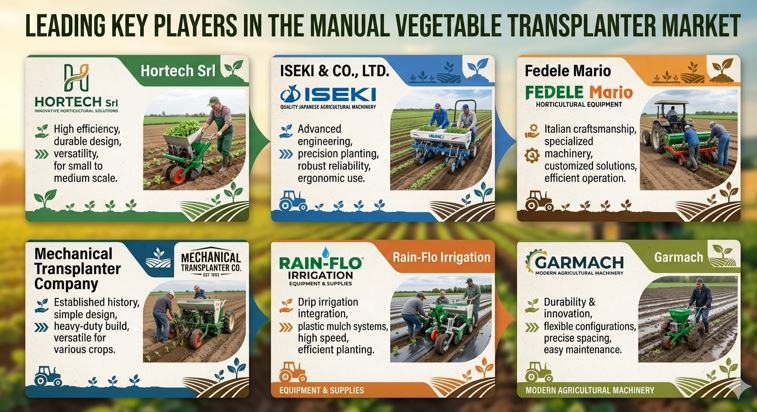
Leading Key Players in the Manual Vegetable Transplanter Market
- Hortech Srl
- ISEKI & CO., LTD.
- Fedele Mario
- Mechanical Transplanter Company
- Rain-Flo Irrigation
- Garmach
- VST Tillers Tractors Ltd.
- BigHaat India
- Nantong FLW Agricultural Equipment
- Terrateck SAS
Manual Vegetable Transplanter Market Segmentation
The global manual vegetable transplanter market is segmented based on type, application, and geography. These market segments help analyze the diverse product categories, end-use applications, and regional demand patterns influencing industry growth. Increasing agricultural mechanization, rising labor shortages, and growing vegetable cultivation activities are contributing to the expansion of various market segments. Manufacturers are focusing on developing efficient and affordable transplanting solutions to meet the requirements of farmers across different agricultural environments and farm sizes.
By Type Analysis
Based on type, the manual vegetable transplanter market can be segmented into single-row manual vegetable transplanters and multi-row manual vegetable transplanters. Each category serves different farming needs depending on land size, crop type, labor availability, and operational efficiency requirements.
The single-row manual vegetable transplanter segment holds a significant share of the market due to its affordability, ease of operation, and suitability for small-scale farming operations. These machines are widely used by small and marginal farmers who cultivate vegetables on limited land areas. Single-row transplanters are preferred because they require less physical effort, are lightweight, and can easily operate in narrow or uneven fields. They are commonly used for transplanting crops such as tomatoes, cabbage, chili peppers, brinjal, and cauliflower.
In many developing economies, small-scale vegetable farming remains dominant, making single-row transplanters highly popular among local farmers. The lower cost of these machines compared to advanced mechanized equipment further supports their adoption. Governments and agricultural organizations are also promoting the use of single-row transplanters through subsidy programs and mechanization initiatives aimed at improving farm productivity.
The multi-row manual vegetable transplanter segment is expected to witness growing demand due to increasing interest in improving planting efficiency and reducing operational time. Multi-row transplanters allow farmers to transplant multiple rows simultaneously, making them suitable for medium-sized farming operations and larger vegetable cultivation areas. These machines help reduce labor requirements and improve field productivity by accelerating planting activities.
Manufacturers are increasingly introducing improved multi-row transplanters with adjustable spacing systems, ergonomic designs, and enhanced durability. These advanced features help improve operational efficiency and attract farmers seeking better performance and higher productivity. Although multi-row transplanters are relatively more expensive than single-row models, their ability to save time and labor makes them attractive for commercial vegetable farming operations.
Both segments are expected to benefit from increasing agricultural mechanization and growing awareness regarding efficient farming practices. Technological improvements and product innovations are likely to further strengthen market growth across both single-row and multi-row transplanter categories.
By Application Analysis
Based on application, the manual vegetable transplanter market is segmented into greenhouse farming, open-field farming, horticulture, and nursery plantation applications. The increasing expansion of vegetable cultivation and protected farming systems is supporting the growth of these application segments.
The open-field farming segment accounts for the largest market share due to the widespread cultivation of vegetables in traditional agricultural fields. Manual vegetable transplanters are extensively used in open-field farming because they help improve planting consistency, reduce labor intensity, and increase productivity. Farmers growing vegetables such as cabbage, tomatoes, onions, peppers, and leafy greens rely on transplanters to enhance operational efficiency during peak planting seasons.
The greenhouse farming segment is also experiencing significant growth as protected agriculture becomes increasingly popular worldwide. Greenhouse vegetable production requires precision planting and proper seedling management to maximize crop quality and yield. Manual vegetable transplanters support accurate seedling placement and efficient transplanting operations within controlled farming environments. The rising adoption of greenhouse farming, especially in regions facing climate-related agricultural challenges, is expected to drive demand for transplanting equipment.
The horticulture segment represents another important application area. Horticulture activities involving the cultivation of fruits, vegetables, herbs, and ornamental plants require efficient seedling transplantation to ensure healthy crop development. Manual transplanters are increasingly being used in horticultural farms to improve labor productivity and planting precision.
The nursery plantation segment is gradually expanding due to increasing demand for healthy seedlings and organized plant production systems. Plant nurseries often require efficient transplantation methods to transfer seedlings from trays to cultivation areas while minimizing plant damage. Manual vegetable transplanters help improve nursery operations by reducing handling stress and ensuring proper planting depth.
Geographical Analysis of Manual Vegetable Transplanter Market
Geographically, the global manual vegetable transplanter market is segmented into North America, Europe, Asia-Pacific, Latin America, and the Middle East & Africa. Regional market growth is influenced by agricultural practices, mechanization levels, labor availability, government support, and vegetable cultivation activities.
Asia-Pacific dominates the global manual vegetable transplanter market due to its large agricultural population and strong vegetable farming industry. Countries such as China, India, Japan, and South Korea are key contributors to regional growth. Increasing labor shortages, rising agricultural mechanization, and government initiatives supporting farm equipment adoption are driving market demand across the region. Small landholdings and labor-intensive farming systems make manual transplanters highly suitable for Asia-Pacific agriculture.
North America represents an important market due to the increasing use of modern agricultural technologies and rising labor costs in farming operations. Farmers in the United States and Canada are increasingly adopting efficient farming tools to improve productivity and reduce dependence on seasonal labor.
Europe is also witnessing steady market growth, supported by the growing emphasis on sustainable farming and advanced horticultural practices. Countries such as Germany, France, Italy, and the Netherlands are investing in precision farming equipment and greenhouse vegetable production systems.
Latin America is emerging as a promising market due to expanding vegetable cultivation activities and increasing awareness regarding mechanized farming equipment. Meanwhile, the Middle East & Africa region is gradually adopting manual vegetable transplanters as governments focus on improving agricultural productivity and food security.
FAQ
1. What is a manual vegetable transplanter?
A manual vegetable transplanter is an agricultural tool used to transplant vegetable seedlings from nursery trays into farm fields. It helps farmers improve planting accuracy, reduce labor effort, and increase operational efficiency during vegetable cultivation.
2. What are the major benefits of using manual vegetable transplanters?
Manual vegetable transplanters offer several benefits, including reduced labor requirements, faster planting operations, uniform seedling spacing, improved crop establishment, and increased productivity. They are also cost-effective compared to fully automated transplanting machines.
3. Which crops are commonly transplanted using manual vegetable transplanters?
These transplanters are widely used for crops such as tomatoes, cabbage, cauliflower, chili peppers, lettuce, onions, brinjal, and other vegetable seedlings that require organized transplantation into agricultural fields.
4. Which region dominates the manual vegetable transplanter market?
Asia-Pacific dominates the global manual vegetable transplanter market due to its large agricultural population, increasing vegetable farming activities, and growing adoption of affordable mechanization tools in countries such as China and India.
5. What factors are driving the growth of the manual vegetable transplanter market?
Key growth factors include rising agricultural mechanization, increasing labor shortages, growing vegetable consumption, government support for modern farming equipment, and the need for efficient and labor-saving agricultural solutions.
