
Global Small Nuclear Reactor Market Introduction
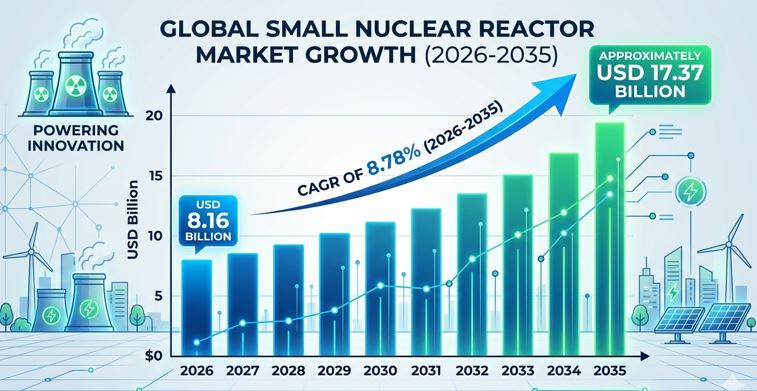
The global small nuclear reactor market size USD 8.16 billion in 2026 to approximately USD 17.37 billion by 2035, expanding at a CAGR of 8.78% from 2026 to 2035.
The small nuclear reactor market is getting a lot of attention because people want reliable energy. Small nuclear reactors or Small Modular Reactors are systems that make electricity on a scale. Most of these Small Modular Reactors can make up to 300 megawatts of power which’s good for a lot of different energy needs.
One reason people like small modular reactors is that they are flexible and they work well. Small Modular Reactors have safety features. They do not take as long to build as big nuclear plants. They also do not cost a lot of money to build. because small modular reactors are small they can be put in places that’re far away or that do not have a lot of power lines. As people try to reduce emissions and make energy safer Small Modular Reactors seem like an idea for making power in the future. Small Modular Reactors are really looking like a solution for the nuclear reactor market and people think Small Modular Reactors can play a big role, in this market.
Climate change and rising carbon emissions are pushing countries to look for cleaner and more reliable energy sources. As a result, Small Modular Reactors (SMRs) are becoming an important part of the global energy conversation. These small nuclear reactors can generate electricity with very low carbon emissions and provide continuous power, unlike solar and wind energy that depend on weather conditions. This makes SMRs a dependable option for countries trying to meet growing electricity demand while reducing their environmental impact.
One of the main reasons SMRs are gaining popularity is their compact and flexible design. These reactors are built in factories and later transported to the locations where they will operate. This process helps reduce construction time and costs. Their smaller size also makes them suitable for remote regions, mining sites, industrial areas, and locations where large nuclear plants are not practical. Energy companies can also increase power generation gradually based on demand, giving SMRs an advantage over traditional large-scale reactors.
Advanced safety features are another key factor driving interest in SMRs. Modern reactors are designed with systems that can cool themselves naturally without relying heavily on human intervention or external power sources. This lowers the risk of accidents and improves public confidence in nuclear technology. In addition, newer reactor designs are being developed to improve fuel efficiency and reduce nuclear waste, making them more sustainable for long-term use.
The growing global demand for electricity is expected to support further growth in the SMR market. Countries such as the United States, Canada, China, Russia, and the United Kingdom are investing in research, funding programs, and supportive policies to accelerate SMR development. Although challenges such as high costs, strict regulations, and concerns about nuclear waste still exist, the demand for reliable low-carbon energy is expected to drive continued interest in Small Modular Reactors in the coming years.
Key Small Nuclear Reactor Market Dynamics
Climate change and rising carbon emissions are pushing countries to look for cleaner ways to produce energy. Because of this, Small Modular Reactors (SMRs) are becoming an important topic in the energy industry. SMRs are small nuclear reactors that can generate electricity with very low greenhouse gas emissions. Unlike solar and wind energy, which depend on weather conditions, SMRs can produce electricity continuously. This makes them a reliable option for countries that need stable and long-term power generation.
One of the main reasons SMRs are gaining popularity is their small and flexible design. These reactors are built in factories and then transported to the places where they will operate. This helps reduce construction time and costs. Their compact size also makes them suitable for remote areas, industrial zones, and mining sites where large nuclear plants may not be practical. Energy companies can also add more power gradually as demand increases, giving SMRs an advantage over traditional large nuclear reactors.
Safety is another important factor driving interest in SMRs. Modern SMRs are designed with advanced safety systems that can cool the reactor naturally without needing much human support or external power. This lowers the risk of accidents and improves public confidence in nuclear technology. New reactor designs are also focused on improving fuel efficiency and reducing nuclear waste, making them more sustainable for long-term use.
The growing demand for electricity around the world is expected to support the future growth of the SMR market. Countries such as the United States, Canada, China, Russia, and the United Kingdom are investing heavily in SMR development through research, funding, and government support. Although the market still faces challenges such as high costs, strict regulations, and concerns about nuclear waste, SMRs are expected to play a bigger role in the future as countries continue to focus on clean and reliable energy solutions.
Small Nuclear Reactor Market Opportunities
The small nuclear reactor market is growing fast because countries and companies are looking for energy that is clean and reliable. Small nuclear reactors, also known as Small Modular Reactors are becoming very popular. They are an alternative to the big nuclear power plants that we have now. Small Modular Reactors are smaller, safer and more flexible which makes them easier to use in places and for different energy needs.
One of the reasons why Small Modular Reactors are a big opportunity is that the world is moving towards clean energy. Many governments are making rules to reduce carbon emissions. They want to use energy that is clean. Small Modular Reactors can provide electricity all the time. They do not make a lot of greenhouse gas emissions. This is different from wind energy, which depend on the weather. As countries try to reduce their use of fuels Small Modular Reactors are going to become more popular.
Energy security is another reason why Small Modular Reactors are getting attention. Some countries have problems with their energy supply. They rely on other countries for fuel. Small Modular Reactors can help by providing a source of energy that is made at home. This makes countries less dependent on countries for energy. The design of Small Modular Reactors is also flexible which makes them useful for both poor countries.
Small Modular Reactors can also help in areas that’re far away from cities and do not have access to reliable electricity. Some mining sites, military bases and rural areas rely on diesel generators for electricity. Small Modular Reactors can provide a term and efficient source of power in these areas. They are small. Can operate for a long time, which makes them suitable for areas that are hard to reach.
The industrial sector is also creating a demand for Small Modular Reactors. Some industries like oil and gas chemical manufacturing and steel production need a lot of energy and heat. As companies try to reduce their carbon emissions they are looking at Small Modular Reactors as a source of energy. Small Modular Reactors can provide both electricity and heat which helps companies reduce their emissions and operate efficiently.
Small Modular Reactors can also help with the production of hydrogen which’s a clean source of energy. Hydrogen is going to play a role in the future of energy especially in industries that are hard to clean up. Small Modular Reactors can provide the energy that is needed to produce hydrogen. As governments and companies invest more in hydrogen Small Modular Reactors are going to become a part of this industry.
Another opportunity for Small Modular Reactors is to replace power plants. Some old power plants are being closed down because they are bad for the environment and they cost a lot to maintain. Small Modular Reactors can replace these plants. Use the existing infrastructure, which reduces costs and makes it easier to switch to cleaner energy.
New technologies are also helping the Small Modular Reactor market grow. New reactor designs, safety systems and monitoring technologies are making Small Modular Reactors safer and more reliable. The way that Small Modular Reactors are built is also changing, which makes them faster and cheaper to build.
Governments are also helping the Small Modular Reactor market grow by providing funding and supporting cooperation. Many countries are working together to develop Small Modular Reactors. They are sharing their knowledge and expertise. This is helping to speed up innovation and reduce costs.
Small Modular Reactors are also an option for countries that are developing quickly. Some countries in Asia, Africa and Latin America are growing fast. They need more electricity. Small Modular Reactors can provide a cost- way to increase access to electricity while reducing carbon emissions.
Small Modular Reactors can also work well with energy sources like solar and wind power. They can provide electricity when the sun is not shining or the wind is not blowing, which helps to keep the grid stable. Hybrid energy systems that combine renewable energy are going to become more common as countries modernize their energy infrastructure.
Overall the Small Modular Reactor market has a lot of potential for growth because of the increasing demand for energy the need for energy and the importance of energy security. As investments in Small Modular Reactors continue to grow and governments provide support Small Modular Reactors are going to play a big role, in the future of clean and reliable energy.
Small Nuclear Reactor Market Trends
The global small nuclear reactor market is evolving rapidly as countries and industries seek cleaner, safer, and more efficient energy solutions. Small nuclear reactors, commonly referred to as Small Modular Reactors (SMRs), are becoming increasingly important in the global energy transition due to their compact design, enhanced safety systems, and ability to provide reliable low-carbon electricity. Several emerging trends are shaping the development of the market, influencing technology innovation, investment patterns, regulatory frameworks, and commercial deployment strategies worldwide.
One of the most prominent trends in the small nuclear reactor market is the growing global emphasis on clean energy transition and decarbonization. Governments and international organizations are intensifying efforts to reduce greenhouse gas emissions and achieve net-zero climate goals. This shift is driving renewed interest in nuclear energy as a stable and low-carbon power source. Unlike conventional fossil fuel power plants, SMRs generate electricity with minimal carbon emissions while offering continuous baseload power generation. As renewable energy sources such as wind and solar continue to expand, small nuclear reactors are increasingly being viewed as complementary technologies capable of ensuring grid stability and energy reliability.
Another major trend is the increasing investment in advanced reactor technologies. Companies and research institutions are focusing on developing next-generation SMRs with improved safety, efficiency, and operational flexibility. Modern reactor designs incorporate passive safety systems that rely on natural processes such as gravity and convection instead of active mechanical systems. These advanced safety mechanisms significantly reduce the risk of accidents and improve public confidence in nuclear energy. In addition, developers are exploring innovative cooling technologies, advanced fuels, and compact reactor architectures to enhance reactor performance and minimize radioactive waste generation.
The adoption of modular construction techniques is also transforming the market landscape. Traditional nuclear power plants often face delays and cost overruns due to complex on-site construction processes. In contrast, SMRs are designed for factory-based manufacturing and modular assembly. Reactor components can be produced in controlled environments and transported to installation sites, reducing construction timelines and improving quality control. This modular approach lowers project risks, reduces labor costs, and enables utilities to scale capacity according to energy demand. As a result, modular construction is becoming a defining trend that supports faster commercialization of small nuclear reactors.
Another important trend is the increasing integration of SMRs with renewable energy systems. Countries transitioning toward cleaner power grids are seeking flexible energy solutions capable of balancing intermittent renewable electricity generation. Small nuclear reactors can provide stable backup power during periods of low solar or wind output, ensuring continuous electricity supply. Hybrid energy systems combining SMRs with renewable technologies are gaining attention for their ability to improve overall grid reliability and maximize clean energy utilization. This trend is expected to strengthen as governments continue investing in diversified and resilient energy infrastructure.
Hydrogen production is emerging as a significant growth trend within the small nuclear reactor market. Clean hydrogen is increasingly recognized as a key solution for decarbonizing heavy industries, transportation, and chemical manufacturing. SMRs can provide the high-temperature heat and continuous electricity required for large-scale hydrogen production through electrolysis and advanced thermochemical processes. Many countries are now exploring the integration of nuclear reactors into hydrogen economy strategies to support low-carbon fuel development. As global demand for hydrogen rises, SMRs are expected to become critical contributors to sustainable hydrogen production initiatives.
The growing deployment of SMRs in remote and off-grid locations is another notable market trend. Mining operations, military facilities, Arctic regions, and isolated communities often face challenges related to energy accessibility and fuel transportation costs. Small nuclear reactors offer a practical solution by delivering long-term, reliable electricity with minimal refueling requirements. Their compact size and scalability make them ideal for areas where conventional large-scale power plants are not feasible. This trend is creating new opportunities for SMR adoption in regions with limited infrastructure and high energy costs.
Government support and international collaboration are also playing an increasingly important role in shaping market trends. Several countries, including the United States, Canada, Russia, China, France, and the United Kingdom, are investing heavily in SMR research, pilot projects, and commercialization programs. Governments are introducing supportive regulatory policies, financial incentives, and funding initiatives to accelerate reactor deployment. At the same time, cross-border partnerships between technology developers, engineering firms, and energy companies are fostering innovation and knowledge sharing. International collaboration is helping standardize safety requirements and streamline licensing processes, which could significantly improve global market expansion.
Digitalization and automation are becoming key trends in modern reactor operations. Advanced monitoring systems, artificial intelligence, predictive maintenance technologies, and digital control platforms are improving reactor efficiency and operational safety. Digital technologies enable real-time performance analysis, reduce maintenance costs, and enhance cybersecurity protection for nuclear facilities. As the nuclear industry increasingly embraces digital transformation, SMR developers are incorporating intelligent operational systems to improve plant reliability and reduce human intervention.
The market is also witnessing rising private sector involvement and venture capital investment. Large energy corporations, technology startups, and institutional investors are recognizing the long-term commercial potential of SMRs. Increased funding is supporting reactor design innovation, supply chain development, and pilot project deployment. Strategic mergers, acquisitions, and partnerships among industry players are becoming more common as companies compete to secure market leadership in advanced nuclear technologies.
Another emerging trend is the repurposing of retired fossil fuel power plant sites for SMR deployment. Utilities are exploring opportunities to replace aging coal-fired plants with small nuclear reactors while utilizing existing grid connections, cooling infrastructure, and skilled workforce resources. This trend supports cleaner energy generation while minimizing infrastructure redevelopment costs and preserving employment opportunities in traditional energy regions.
Leading Key Players in the Small Nuclear Reactor Market
- DB Schenker
- CEVA Logistic
- Agility Logistics
- C.H. Robinso
- Kerry Logistics
- Nippon Express
- DSV
- SF Express
- AmerisourceBergen
- Cardinal Health
- Maersk
Small Nuclear Reactor Market Segmentation
The global small nuclear reactor market is segmented based on reactor type, application, and geography. Market segmentation plays a critical role in understanding the various growth opportunities, technological developments, and end-user requirements within the industry. Small nuclear reactors, also referred to as Small Modular Reactors (SMRs), are designed to offer scalable, efficient, and low-carbon energy solutions across multiple sectors. Their flexible deployment capabilities and advanced safety systems make them suitable for a wide range of commercial, industrial, and utility-based applications.
The increasing global demand for clean energy, rising investments in nuclear innovation, and supportive government policies are contributing to the expansion of all market segments. Different reactor technologies and applications are evolving rapidly to meet changing energy demands and sustainability objectives. Understanding these market segments provides insight into future growth areas and investment opportunities in the global small nuclear reactor industry.
By Type Analysis
Based on type, the small nuclear reactor market is segmented into Pressurized Water Reactors (PWRs), Heavy Water Reactors (HWRs), High-Temperature Gas-Cooled Reactors (HTGRs), Fast Neutron Reactors (FNRs), Molten Salt Reactors (MSRs), and others.
Pressurized Water Reactors currently dominate the market due to their established operational reliability, proven technology, and widespread adoption in conventional nuclear power generation. Many SMR developers are adapting PWR technology into smaller modular formats because of existing infrastructure compatibility and regulatory familiarity. These reactors use water as both coolant and moderator, offering high safety standards and efficient heat transfer capabilities. Their ability to integrate with existing nuclear supply chains further supports market growth.
Heavy Water Reactors are gaining attention due to their capability to use natural uranium as fuel, reducing fuel enrichment requirements. These reactors provide improved fuel efficiency and are particularly attractive for countries seeking cost-effective nuclear power solutions. Heavy water technology also offers operational flexibility and long fuel cycles, making it suitable for long-term energy generation projects.
High-Temperature Gas-Cooled Reactors represent one of the most promising advanced reactor technologies in the market. These reactors use helium gas as a coolant and can operate at significantly higher temperatures compared to conventional reactors. The high-temperature output allows HTGRs to support industrial heat applications, hydrogen production, and efficient electricity generation. Their enhanced thermal efficiency and passive safety systems are driving increasing research and investment activities globally.
Fast Neutron Reactors are another emerging segment with strong future potential. These reactors use fast neutrons instead of thermal neutrons to sustain nuclear reactions, enabling better fuel utilization and reduced nuclear waste generation. Fast reactors can also recycle spent nuclear fuel, improving long-term sustainability within the nuclear energy sector. As countries focus on advanced fuel cycle technologies and waste reduction strategies, demand for fast neutron reactors is expected to grow steadily.
Molten Salt Reactors are gaining significant interest due to their innovative design and enhanced safety characteristics. These reactors use molten salt as both fuel carrier and coolant, enabling operation at low pressure while maintaining high efficiency levels. MSRs offer advantages such as reduced meltdown risks, efficient fuel utilization, and lower waste production. Their potential applications in electricity generation, industrial heating, and clean hydrogen production are attracting investments from governments and private companies.
Other reactor types include microreactors and hybrid reactor technologies designed for niche applications such as military operations, remote energy supply, and off-grid industrial activities. These advanced systems are expected to contribute to future market diversification as technology development progresses.
By Application Analysis
Based on application, the small nuclear reactor market is segmented into power generation, desalination, industrial applications, hydrogen production, district heating, and others.
Power generation remains the largest application segment in the market. Small nuclear reactors are increasingly being adopted as reliable low-carbon alternatives to fossil fuel-based electricity generation. Their ability to provide continuous baseload power while supporting renewable energy integration makes them highly attractive for modern energy systems. Utilities and governments are investing heavily in SMRs to improve grid stability, reduce emissions, and meet growing electricity demand.
Desalination is emerging as a significant application area, particularly in water-scarce regions. Small nuclear reactors can provide the large amounts of energy required for seawater desalination processes while minimizing environmental impact. Countries in the Middle East, North Africa, and parts of Asia are exploring nuclear-powered desalination projects to address freshwater shortages and improve long-term water security.
Industrial applications are becoming increasingly important within the market. Industries such as oil and gas, mining, steel manufacturing, chemical processing, and petrochemicals require stable and high-capacity energy supplies. SMRs can provide both electricity and process heat for industrial operations, helping companies reduce carbon emissions and improve operational efficiency. Industrial adoption is expected to increase as businesses pursue sustainability and energy diversification goals.
Hydrogen production is another rapidly growing application segment. Clean hydrogen is gaining global attention as a future fuel for transportation, heavy industries, and energy storage systems. Small nuclear reactors can support hydrogen generation through electrolysis and thermochemical processes by supplying stable electricity and high-temperature heat. As governments invest in hydrogen economy development, SMRs are expected to play a critical role in supporting low-carbon hydrogen production infrastructure.
District heating applications are also creating new growth opportunities. Small nuclear reactors can supply heat directly to residential and commercial districts through centralized heating networks. This approach improves overall energy efficiency and reduces reliance on fossil fuels for heating purposes, particularly in colder regions with high seasonal heating demand.
Other applications include military energy supply, marine propulsion, and remote infrastructure support. The flexibility and compact design of SMRs make them suitable for specialized operations where reliable long-term energy generation is essential.
Geographical Analysis of Small Nuclear Reactor Market
The small nuclear reactor market is growing at different speeds around the world. Growth is being driven by factors such as government support, rising energy demand, technology development, and environmental goals. Regions including North America, Europe, Asia-Pacific, Latin America, and the Middle East & Africa are all playing important roles in the development of the Small Modular Reactor (SMR) market.
North America currently leads the SMR market because of strong government support, advanced nuclear technology, and high investment in research and development. The United States is one of the leading countries in SMR innovation, with several reactor projects and partnerships between government organizations and private companies. Government agencies are providing funding, regulatory support, and licensing systems to help speed up SMR development. Canada is also investing heavily in SMR technology to support clean energy goals, remote power generation, and industrial decarbonization.
Europe is another important market for small nuclear reactors. Countries such as the United Kingdom, France, and Poland are focusing on SMRs as part of their long-term clean energy strategies. These countries want to reduce dependence on imported fossil fuels and improve energy security. At the same time, the Asia-Pacific region is expected to see the fastest growth due to rapid industrial development, population growth, and rising electricity demand. China and Russia are investing heavily in advanced nuclear technologies and commercial reactor projects, while India, Japan, and South Korea are also exploring SMR technologies to improve energy security and support economic growth.
Latin America is slowly emerging as a potential market for SMRs as countries look for affordable and reliable clean energy solutions. Awareness about the benefits of nuclear energy is increasing across the region, which may create future opportunities for SMR projects. Meanwhile, the Middle East & Africa region is also showing growing interest in small nuclear reactors, especially for desalination and remote energy applications. Countries such as the United Arab Emirates and Saudi Arabia are investing in advanced energy infrastructure and studying the use of SMRs to support long-term sustainability and energy security goals.
FAQ
What is a Small Nuclear Reactor (SMR)?
A Small Nuclear Reactor (SMR) is a compact nuclear power system designed to generate electricity on a smaller scale compared to traditional nuclear power plants. These reactors typically produce up to 300 megawatts (MW) of electricity and are built using modular technology, allowing easier transportation, faster installation, and improved operational flexibility.
What are the major advantages of Small Nuclear Reactors?
Small Nuclear Reactors offer several advantages, including lower carbon emissions, enhanced safety systems, reduced construction time, and scalable power generation. Their compact design allows deployment in remote locations, industrial facilities, and regions with limited infrastructure. SMRs also provide reliable baseload electricity and can support renewable energy integration.
Which industries can benefit from Small Nuclear Reactors?
Several industries can benefit from SMRs, including power generation, oil and gas, mining, chemical manufacturing, desalination, hydrogen production, and district heating. These reactors can provide both electricity and industrial process heat, helping industries reduce dependence on fossil fuels and lower carbon emissions.
Which regions are leading the Small Nuclear Reactor market?
North America, Europe, and Asia-Pacific are currently the leading regions in the global SMR market. Countries such as the United States, Canada, China, Russia, and the United Kingdom are heavily investing in advanced nuclear technologies, research programs, and pilot reactor deployment projects to support clean energy and energy security goals.
What challenges does the Small Nuclear Reactor market face?
The market faces several challenges, including high initial investment costs, complex regulatory approval processes, public concerns regarding nuclear safety, and radioactive waste management issues. However, advancements in reactor technology, supportive government policies, and increasing global demand for clean energy are expected to drive future market growth.
