
Global DC Load Bank Market Introduction
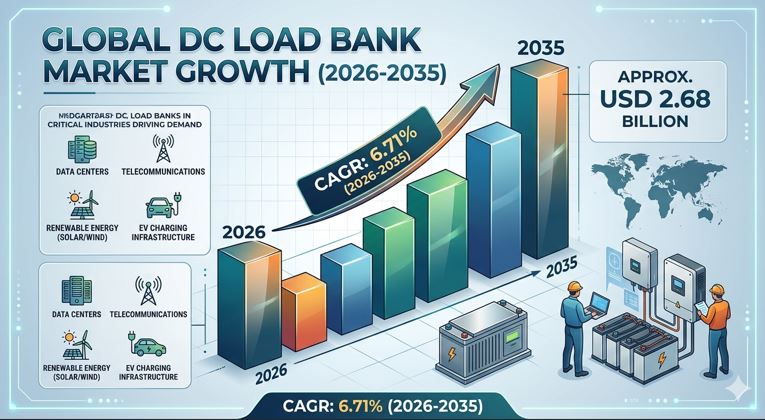
The global DC load bank market size USD 1.49 billion in 2026 to approximately USD 2.68 billion by 2035, expanding at a CAGR of 6.71% from 2026 to 2035.
The global DC load bank market plays a critical role in the testing, maintenance, and validation of direct current (DC) power systems used across a wide range of industries. A DC load bank is an electrical testing device designed to simulate real electrical loads on DC power sources such as batteries, uninterruptible power supplies (UPS), rectifiers, generators, and renewable energy storage systems. By applying a controlled load, DC load banks help evaluate the performance, capacity, efficiency, and reliability of power systems under real-world operating conditions without connecting them to actual operational equipment.
DC load banks are widely used in industries where uninterrupted and reliable power supply is essential, including data centers, telecommunications, power generation, oil and gas, marine, aerospace, and defense sectors. As global dependence on continuous power infrastructure increases, the demand for efficient testing and maintenance solutions has also grown significantly. This has positioned the DC load bank market as an essential segment within the broader electrical testing and power management industry.
One of the key drivers of the global DC load bank market is the rapid expansion of data centers and telecommunication networks. Modern data centers rely heavily on backup power systems such as batteries and UPS units to ensure uninterrupted operations. Regular testing of these systems using DC load banks is necessary to verify their reliability during power outages. Similarly, the expansion of 5G networks and telecom infrastructure has increased the demand for stable and efficient DC power systems, further supporting market growth.
The growing adoption of renewable energy systems, particularly solar and wind power, is another significant factor contributing to market expansion. Renewable energy installations often incorporate battery energy storage systems (BESS) to store and supply DC power. DC load banks are used to test and validate these storage systems, ensuring they perform efficiently under varying load conditions. As countries worldwide transition toward cleaner energy sources, the need for reliable energy storage testing solutions is expected to increase substantially.
Industrial automation and digitalization have also strengthened the demand for DC load banks. Industries are increasingly adopting advanced electrical systems that require regular monitoring and testing to prevent failures and optimize performance. DC load banks help operators identify potential issues such as battery degradation, system inefficiencies, and voltage irregularities before they lead to critical failures. This preventive maintenance approach enhances operational reliability and reduces downtime costs.
Technological advancements have further enhanced the capabilities of DC load banks. Modern systems are equipped with digital control interfaces, automated testing features, remote monitoring capabilities, and data logging functions. These innovations allow for more precise testing, improved safety, and better integration with industrial control systems. Portable and compact DC load banks are also gaining popularity due to their ease of use and flexibility in field applications.
The market is also influenced by stringent safety regulations and industry standards that mandate regular testing of power backup systems. Industries such as healthcare, aerospace, and defense require highly reliable power infrastructure, where even minor failures can lead to significant operational risks. As a result, regulatory compliance is driving organizations to adopt routine load testing practices using DC load banks.
Geographically, North America and Europe represent mature markets due to the presence of advanced industrial infrastructure, data center hubs, and strict regulatory frameworks. However, the Asia-Pacific region is expected to witness the fastest growth during the forecast period. Rapid industrialization, expanding telecommunications networks, and increasing investments in renewable energy projects in countries such as China, India, Japan, and South Korea are fueling demand for DC load banks in the region.
Despite strong growth prospects, the market faces certain challenges, including high initial equipment costs and the need for skilled technicians to operate complex testing systems. Additionally, fluctuations in raw material prices and supply chain disruptions can impact manufacturing and distribution.
Overall, the global DC load bank market is expected to experience steady growth in the coming years, driven by increasing demand for reliable power systems, expansion of data centers and renewable energy infrastructure, and growing emphasis on preventive maintenance and system reliability. As industries continue to prioritize operational efficiency and power stability, DC load banks will remain a vital tool in ensuring the safe and effective performance of critical electrical systems worldwide.
Key DC Load Bank Market Dynamics
The global DC load bank market is shaped by a combination of technological advancements, expanding critical power infrastructure, rising demand for reliable backup systems, and increasing focus on preventive maintenance across industries. DC load banks, which are used to simulate electrical loads on DC power sources such as batteries, UPS systems, rectifiers, and energy storage units, have become essential tools for ensuring the reliability and efficiency of power systems. The market dynamics are continuously evolving as industries modernize their power infrastructure and adopt more complex energy management systems.
One of the primary drivers influencing the DC load bank market dynamics is the rapid expansion of data centers and digital infrastructure. With the increasing reliance on cloud computing, artificial intelligence, and big data analytics, data centers require highly reliable uninterrupted power supply systems. DC load banks are widely used to test battery backup systems and UPS units to ensure they can perform effectively during power failures. This growing dependency on digital infrastructure has significantly increased the frequency and importance of load testing procedures.
Another key factor shaping the market is the rising adoption of renewable energy systems and energy storage technologies. As countries transition toward sustainable energy sources such as solar and wind power, the need for efficient battery energy storage systems (BESS) has increased. DC load banks are essential for testing and validating these storage systems under controlled conditions. They help ensure that batteries can handle varying load demands, maintain stability, and deliver consistent performance. This trend is particularly strong in regions investing heavily in clean energy infrastructure.
Industrial automation and the modernization of electrical systems also play a major role in driving market dynamics. Industries such as manufacturing, oil and gas, mining, and marine operations depend on stable DC power systems for critical operations. DC load banks are used for routine maintenance testing to identify issues such as battery degradation, voltage fluctuations, and system inefficiencies. This preventive maintenance approach helps reduce unexpected downtime, improve operational safety, and extend the lifespan of expensive power equipment.
Technological advancements are further transforming the DC load bank market. Modern load banks now feature digital control systems, automated testing capabilities, remote monitoring, and real-time data analysis. These innovations have improved testing accuracy, safety, and efficiency. Portable and modular DC load banks are also gaining traction, especially for field applications where flexibility and mobility are important. Integration with smart grid systems and industrial IoT platforms is another emerging trend that enhances performance monitoring and predictive maintenance.
Regulatory and safety requirements are also significant factors influencing market dynamics. Many industries, particularly healthcare, telecommunications, defense, and aviation, are required to maintain highly reliable backup power systems. Regulatory standards mandate periodic testing of batteries and power systems to ensure readiness during emergencies. This has increased the adoption of DC load banks as a standard maintenance tool across critical infrastructure sectors.
However, the market also faces certain restraints. High initial investment costs for advanced DC load bank systems can limit adoption, especially among small and medium-sized enterprises. Additionally, the need for skilled personnel to operate and interpret testing results can pose operational challenges. Complex system integration requirements and maintenance costs also add to the overall burden for end users.
Despite these challenges, several opportunities are emerging in the market. The growing focus on energy efficiency, grid modernization, and smart infrastructure is expected to create strong demand for advanced load testing solutions. Expanding investments in renewable energy projects and battery storage systems will further strengthen market growth. Additionally, increasing digitalization and adoption of predictive maintenance technologies are expected to enhance the role of DC load banks in modern power management systems.
Regionally, North America and Europe continue to dominate the market due to established industrial infrastructure, strong presence of data centers, and strict regulatory frameworks. Meanwhile, Asia-Pacific is emerging as the fastest-growing region, driven by rapid industrialization, expanding telecom networks, and increasing investments in renewable energy projects.
Key DC Load Bank Market Restraints
Despite steady growth and increasing adoption across industries, the global DC load bank market faces several restraints that can limit its expansion. These challenges are mainly related to high capital costs, operational complexities, limited awareness in certain regions, and evolving alternatives in power testing and monitoring technologies. While DC load banks are essential for ensuring the reliability of backup power systems, their adoption is not uniform across all end-user industries, especially in cost-sensitive and developing markets.
One of the primary restraints in the DC load bank market is the high initial investment required for advanced systems. Modern DC load banks equipped with digital controls, automation features, remote monitoring, and high-capacity testing capabilities tend to be expensive. This makes them less accessible for small and medium-sized enterprises (SMEs), particularly in emerging economies. In addition to the purchase cost, installation, maintenance, and periodic calibration expenses further increase the total cost of ownership, discouraging widespread adoption among budget-constrained users.
Another significant challenge is the operational complexity associated with DC load banks. Proper use of these systems requires trained technicians who understand electrical load testing, system behavior, and data interpretation. Incorrect usage can lead to inaccurate results or even damage to the power systems being tested. Many organizations, especially in developing regions, face a shortage of skilled professionals capable of handling advanced load testing equipment. This skills gap limits market penetration and slows down adoption rates.
Limited awareness about the importance of regular load testing is also a key restraint in certain industries and regions. While large-scale data centers, telecom operators, and critical infrastructure facilities routinely use DC load banks, smaller industries may not fully understand the necessity of periodic testing of batteries and backup power systems. As a result, they may delay or avoid investing in load bank solutions, relying instead on basic monitoring methods that do not provide comprehensive performance validation.
The availability of alternative testing and monitoring technologies also poses a challenge to market growth. Advanced battery management systems (BMS), real-time monitoring tools, and predictive analytics software are increasingly being used to assess battery health and performance without requiring full load testing. While these solutions do not completely replace DC load banks, they can reduce the frequency of their usage, thereby impacting demand growth in certain applications.
Logistical and operational constraints further affect market expansion. DC load banks, especially high-capacity industrial units, are often large, heavy, and require significant space and proper handling. Transportation, installation, and deployment in remote or confined locations can be challenging and costly. This limits their practicality in certain field applications where mobility and space constraints are critical factors.
Economic fluctuations and budget constraints in end-use industries can also restrain market growth. During periods of economic slowdown, companies often reduce capital expenditure on maintenance equipment and delay infrastructure upgrades. Since DC load banks are primarily used for preventive maintenance rather than direct revenue generation, they may be deprioritized during cost-cutting cycles.
Additionally, stringent safety and regulatory compliance requirements can act as both a driver and a restraint. While regulations encourage regular testing, they also impose strict standards for equipment certification, operation, and maintenance. Meeting these requirements can increase compliance costs and slow down product deployment.
DC Load Bank Market Opportunities
The global DC load bank market is witnessing strong growth potential driven by rapid advancements in power infrastructure, increasing demand for reliable backup systems, and the global transition toward clean and renewable energy sources. As industries continue to prioritize uninterrupted power supply, system reliability, and preventive maintenance, DC load banks are becoming increasingly important across multiple sectors. This evolving landscape is creating several promising opportunities for manufacturers, service providers, and technology developers in the market.
One of the most significant opportunities lies in the rapid expansion of data centers worldwide. With the exponential growth of cloud computing, artificial intelligence, big data analytics, and digital services, the demand for data storage and processing facilities is increasing rapidly. Data centers rely heavily on uninterrupted power systems such as batteries and UPS units to ensure continuous operations. DC load banks are essential for testing these backup systems, creating a strong and sustained demand for advanced load testing solutions. As hyperscale data centers continue to expand, the need for efficient and automated load testing systems is expected to grow significantly.
The increasing adoption of renewable energy systems and battery energy storage technologies also presents a major opportunity for the DC load bank market. Solar and wind energy projects depend on energy storage systems to stabilize power output and ensure continuous supply. DC load banks play a crucial role in testing and validating battery storage systems to ensure efficiency, safety, and performance reliability. With governments and private players investing heavily in clean energy infrastructure, demand for energy storage testing solutions is expected to rise steadily.
Another important opportunity is the modernization of industrial infrastructure and the growing focus on predictive maintenance. Industries such as oil and gas, manufacturing, marine, aviation, and mining require highly reliable power systems to avoid costly downtime and operational failures. DC load banks help in identifying battery degradation, system inefficiencies, and performance issues before they lead to critical failures. The shift toward predictive and condition-based maintenance strategies is increasing the adoption of advanced load testing equipment, creating new growth avenues for market players.
Technological advancements in DC load bank systems are also opening new opportunities. The integration of digital control systems, remote monitoring, cloud connectivity, and automation features is enhancing the functionality and usability of modern load banks. These innovations allow real-time data analysis, improved accuracy, and easier system management. Portable and modular DC load banks are also gaining traction, especially for field applications where flexibility and mobility are important. Manufacturers investing in smart, IoT-enabled load bank solutions are likely to gain a competitive advantage in the evolving market.
The growing demand for smart grids and modernized power distribution systems further supports market expansion. As electrical grids become more complex and decentralized, the need for reliable testing of DC power systems increases. Load banks are essential tools for ensuring grid stability, validating energy storage systems, and supporting backup power infrastructure in smart grid environments.
Emerging economies in Asia-Pacific, Latin America, and the Middle East & Africa offer significant growth opportunities due to rapid industrialization, increasing energy demand, and expanding telecommunications networks. Countries such as India, China, Brazil, and the United Arab Emirates are investing heavily in infrastructure development, renewable energy projects, and digital transformation, creating strong demand for DC load bank solutions.
Additionally, the increasing emphasis on safety regulations and compliance standards in critical industries such as healthcare, defense, and telecommunications is driving the adoption of regular load testing practices. This regulatory push is encouraging organizations to invest in reliable and efficient DC load bank systems to ensure operational readiness and safety compliance.
DC Load Bank Market Drivers
The global DC load bank market is experiencing steady growth, driven by the increasing need for reliable power systems, rising dependence on uninterrupted electricity supply, and rapid expansion of critical infrastructure such as data centers, telecommunications networks, and renewable energy installations. DC load banks play a vital role in testing and validating the performance of batteries, UPS systems, rectifiers, and energy storage systems, ensuring operational reliability and safety across various industries. Several key drivers are contributing to the strong expansion of this market.
One of the primary drivers is the rapid growth of data centers and digital infrastructure. With the global rise in cloud computing, artificial intelligence, machine learning, and big data analytics, data centers have become essential for modern business operations. These facilities require highly reliable backup power systems to prevent downtime and data loss. DC load banks are extensively used to test battery banks and UPS systems to ensure they can handle real-world power failures effectively. As hyperscale and colocation data centers continue to expand globally, the demand for load testing solutions is increasing significantly.
The growing adoption of renewable energy systems is another major factor driving market growth. Solar and wind energy installations rely heavily on battery energy storage systems (BESS) to store and distribute electricity efficiently. DC load banks are essential for testing these storage systems to ensure their performance, stability, and capacity under different load conditions. As governments and private organizations invest heavily in clean energy transition and decarbonization goals, the need for reliable energy storage testing solutions is expected to rise further.
Increasing emphasis on preventive maintenance and system reliability across industries is also fueling demand for DC load banks. Industries such as oil and gas, marine, manufacturing, aviation, healthcare, and defense depend on uninterrupted power supply for critical operations. Even minor power failures can lead to significant operational disruptions and financial losses. DC load banks help identify issues such as battery degradation, voltage instability, and system inefficiencies before they result in failures. This proactive maintenance approach is encouraging widespread adoption of load testing systems.
Technological advancements in load bank systems are further contributing to market growth. Modern DC load banks are equipped with digital control interfaces, automated testing capabilities, real-time monitoring, and data logging features. These advancements improve testing accuracy, enhance safety, and reduce operational complexity. The integration of IoT and smart monitoring systems allows remote operation and predictive maintenance, making load testing more efficient and cost-effective.
The expansion of telecommunications infrastructure, particularly the rollout of 5G networks, is another significant driver. Telecom towers and base stations rely on battery backup systems to ensure uninterrupted service. DC load banks are used to regularly test these systems to guarantee reliability during power outages. As global connectivity demands increase, telecom operators are investing more in robust power testing solutions.
Strict regulatory standards and safety requirements in critical industries are also boosting demand for DC load banks. Sectors such as healthcare, aerospace, and defense are required to maintain highly reliable backup power systems and conduct periodic testing to ensure compliance. These regulations are encouraging organizations to adopt standardized load testing procedures using DC load banks.
Additionally, rising global energy consumption and increasing complexity of power systems are pushing industries to adopt advanced testing solutions. As electrical infrastructure becomes more sophisticated, ensuring system stability and performance becomes increasingly important, further strengthening the need for DC load banks.
DC Load Bank Market Trends
The global DC load bank market is evolving rapidly as industries modernize their power infrastructure, adopt renewable energy systems, and increasingly rely on uninterrupted power supply for critical operations. DC load banks, which are used to simulate electrical loads for testing batteries, UPS systems, rectifiers, and energy storage systems, are becoming more advanced, intelligent, and widely deployed. Several key trends are shaping the future of this market, including digitalization, renewable energy integration, automation, portability, and the growing focus on predictive maintenance.
One of the most significant trends in the DC load bank market is the increasing adoption of digital and smart load testing systems. Traditional load banks are being replaced or upgraded with advanced models featuring digital control panels, touchscreen interfaces, and automated testing capabilities. These systems allow operators to perform precise load tests, monitor performance in real time, and generate detailed reports for analysis. The integration of software-based controls and remote monitoring capabilities has improved accuracy, efficiency, and ease of use, making load testing more accessible even in complex industrial environments.
Another major trend is the integration of Internet of Things (IoT) and cloud-based monitoring systems. Modern DC load banks are increasingly connected to centralized platforms that enable remote operation, real-time diagnostics, and predictive analytics. This allows maintenance teams to monitor power system performance from anywhere, identify potential failures early, and schedule preventive maintenance more effectively. IoT-enabled load banks are particularly valuable in large-scale data centers, telecom networks, and renewable energy installations where continuous monitoring is essential.
The rapid expansion of renewable energy and energy storage systems is also influencing market trends. As solar and wind power projects grow globally, battery energy storage systems (BESS) are becoming essential for stabilizing energy supply. DC load banks are widely used to test and validate these storage systems to ensure they can handle varying loads and maintain consistent performance. This trend is driving demand for high-capacity, efficient, and accurate load testing solutions capable of supporting large-scale energy infrastructure.
Portability and modular design are emerging as important trends in the DC load bank market. Industries are increasingly seeking compact, lightweight, and mobile load banks that can be easily transported and deployed in field conditions. Portable DC load banks are particularly useful in remote installations, temporary testing sites, and emergency maintenance operations. Modular systems that can be scaled according to testing requirements are also gaining popularity, as they offer flexibility and cost efficiency.
Predictive maintenance and condition-based monitoring are becoming central to industrial operations, further shaping the DC load bank market. Instead of relying solely on scheduled maintenance, industries are now using real-time data and analytics to predict equipment failures before they occur. DC load banks play a crucial role in this strategy by simulating real-world load conditions and helping operators assess battery health, system efficiency, and performance degradation. This trend is especially strong in critical sectors such as healthcare, aerospace, defense, and telecommunications.
The growing emphasis on energy efficiency and sustainability is another important trend. Organizations are increasingly focused on reducing energy waste, improving system efficiency, and lowering operational costs. DC load banks help optimize power systems by ensuring that batteries and backup systems operate efficiently and reliably. Manufacturers are also developing energy-efficient load banks that consume less power and generate minimal heat during testing.
Another notable trend is the increasing use of DC load banks in hyperscale data centers. As global data consumption continues to rise, large-scale data centers are expanding rapidly. These facilities require highly reliable backup power systems, and regular testing using DC load banks is essential to ensure uninterrupted operation. Automated load testing systems are becoming standard in modern data centers to maintain uptime and prevent service disruptions.
In addition, advancements in battery technology are influencing market trends. The development of lithium-ion batteries and other advanced energy storage solutions requires more sophisticated testing methods. DC load banks are being designed to accommodate higher energy densities, faster charging cycles, and more complex performance parameters associated with modern battery systems.
Geographically, Asia-Pacific is emerging as a key trendsetter in market growth due to rapid industrialization, expansion of telecom networks, and large-scale renewable energy investments. Meanwhile, North America and Europe continue to lead in technological innovation, digital adoption, and regulatory compliance standards.
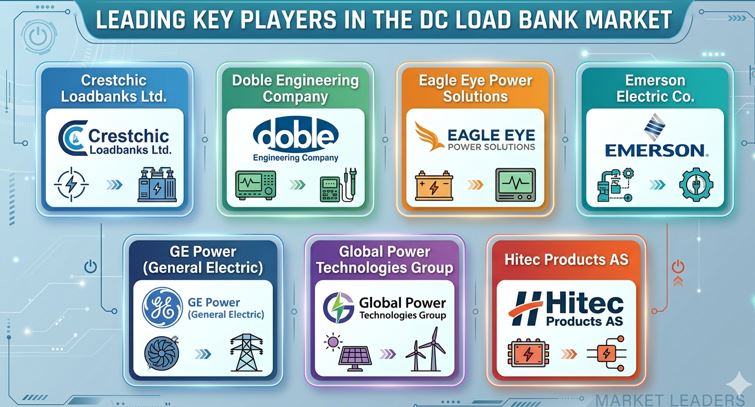
Leading Key Players in the DC Load Bank Market
- Crestchic Loadbanks Ltd.
- Doble Engineering Company
- Eagle Eye Power Solutions
- Emerson Electric Co.
- GE Power (General Electric)
- Global Power Technologies Group
- Hitec Products AS
- Joventa Ltd.
- Korea Electric Power Corporation (KEPCO)
- Loadbanks.com
- MTE Corporation
- Princeton Power Systems, Inc.
- Shenzhen SROH Technology Co., Ltd.
DC Load Bank Market Segmentation
The global DC load bank market is segmented based on type, application, and geography. This segmentation helps in understanding demand patterns, technological preferences, and regional growth variations across different end-use industries. As industries increasingly rely on uninterrupted DC power systems such as batteries, UPS units, rectifiers, and renewable energy storage systems, the demand for efficient testing solutions continues to expand. DC load banks play a crucial role in ensuring system reliability, performance validation, and preventive maintenance, making them essential across multiple sectors.
By Type Analysis
Based on type, the DC load bank market is segmented into resistive DC load banks, reactive DC load banks, and resistive-reactive DC load banks.
Resistive DC load banks dominate the market due to their widespread use in testing batteries, UPS systems, and DC power supplies. These load banks simulate real electrical loads by converting electrical energy into heat, allowing operators to evaluate battery capacity, discharge performance, and overall system reliability. They are commonly used in data centers, telecommunications, and industrial facilities where precise load testing of DC systems is required. Their simplicity, cost-effectiveness, and ease of operation make them highly preferred across various applications.
Reactive DC load banks, although less commonly used for DC systems compared to AC applications, are designed for specialized testing scenarios where inductive or capacitive load simulation is required. These systems are typically used in advanced industrial environments and research applications where detailed power behavior analysis is necessary. Their use is more niche but critical for specific technical evaluations.
Resistive-reactive DC load banks combine both resistive and reactive elements, offering more comprehensive testing capabilities. These systems are capable of simulating complex load conditions, making them suitable for advanced testing of hybrid power systems and large-scale energy storage solutions. With the growing complexity of modern power infrastructure, demand for hybrid load bank systems is gradually increasing.
By Application Analysis
Based on application, the DC load bank market is segmented into data centers, telecommunications, power generation, oil and gas, marine, aerospace and defense, and industrial manufacturing.
The data center segment holds a dominant share in the market due to the critical need for uninterrupted power supply and high system reliability. Data centers rely heavily on UPS systems and battery backups to ensure continuous operations, and DC load banks are essential for regularly testing these systems. With the rapid expansion of cloud computing, artificial intelligence, and digital services, demand for load testing solutions in data centers is expected to grow significantly.
The telecommunications sector is another major application area. Telecom towers, base stations, and network infrastructure require reliable DC power systems to maintain uninterrupted communication services. DC load banks are widely used to test battery backup systems that support telecom operations during power outages. The ongoing global rollout of 5G networks is further boosting demand in this segment.
The power generation sector also contributes significantly to market growth. Power plants use DC load banks to test battery systems, control systems, and backup power units to ensure operational reliability. Similarly, the oil and gas industry relies on DC load banks for testing offshore platforms, refineries, and remote installations where power stability is critical.
In the marine industry, DC load banks are used to test shipboard power systems, navigation equipment, and emergency backup systems. The aerospace and defense sectors require highly reliable power systems, making DC load banks essential for testing mission-critical equipment under strict safety standards.
Industrial manufacturing facilities also use DC load banks for maintaining backup power systems and ensuring uninterrupted production processes. As automation and digitalization increase in manufacturing, the need for reliable power testing solutions continues to grow.
Geographical Analysis of DC Load Bank Market
The global DC load bank market is geographically segmented into North America, Europe, Asia-Pacific, Latin America, and the Middle East & Africa, each contributing differently based on industrial development, infrastructure investment, and technological adoption.
North America holds a significant share of the market due to the presence of advanced data centers, strong telecommunications infrastructure, and high adoption of renewable energy systems. The United States is a key contributor, driven by investments in cloud computing, hyperscale data centers, and stringent regulatory requirements for power system reliability. The region also benefits from early adoption of advanced load testing technologies and strong industrial automation practices.
Europe is another major market, supported by strict energy efficiency regulations, growing focus on renewable energy integration, and strong industrial base. Countries such as Germany, the United Kingdom, and France are investing heavily in smart grid systems and energy storage technologies, driving demand for DC load banks. The region’s emphasis on sustainability and energy transition further supports market growth.
Asia-Pacific is expected to witness the fastest growth in the DC load bank market. Rapid industrialization, urbanization, and expansion of telecommunications and data center infrastructure are key growth drivers. Countries such as China, India, Japan, and South Korea are heavily investing in renewable energy projects, 5G deployment, and digital infrastructure, significantly increasing demand for reliable power testing solutions. The region’s large population base and rising energy consumption further contribute to market expansion.
Latin America is experiencing steady growth due to increasing investments in industrial infrastructure, telecommunications, and power generation. Countries such as Brazil and Mexico are emerging as important markets for DC load bank adoption, particularly in energy and industrial sectors.
The Middle East & Africa region is also showing gradual growth, driven by investments in oil and gas infrastructure, smart city projects, and renewable energy initiatives. Countries in the Gulf Cooperation Council (GCC) are focusing on diversifying their energy mix and improving power reliability, which is boosting demand for DC load banks.
FAQ
What is a DC load bank used for?
A DC load bank is used to simulate electrical loads on DC power sources such as batteries, UPS systems, rectifiers, and energy storage systems. It helps test performance, capacity, and reliability under controlled conditions without connecting to real operational equipment.
Which industries commonly use DC load banks?
DC load banks are widely used in data centers, telecommunications, power generation, oil and gas, marine, aerospace and defense, and industrial manufacturing. These industries rely on uninterrupted power systems that require regular testing and maintenance.
Why is DC load bank testing important?
DC load bank testing is important because it helps identify issues such as battery degradation, voltage instability, and system inefficiencies before failures occur. This ensures backup power systems are reliable during emergencies and reduces downtime risks.
What are the main types of DC load banks?
The main types include resistive DC load banks, reactive DC load banks, and resistive-reactive DC load banks. Each type is used for different testing requirements, ranging from basic battery testing to complex power system simulations.
What factors are driving the growth of the DC load bank market?
Key growth drivers include the expansion of data centers, increasing adoption of renewable energy systems, rising demand for reliable backup power, growth in telecommunications infrastructure, and increasing focus on preventive maintenance and system reliability.
