
Global Outdoor Commercial Grills Market Introduction
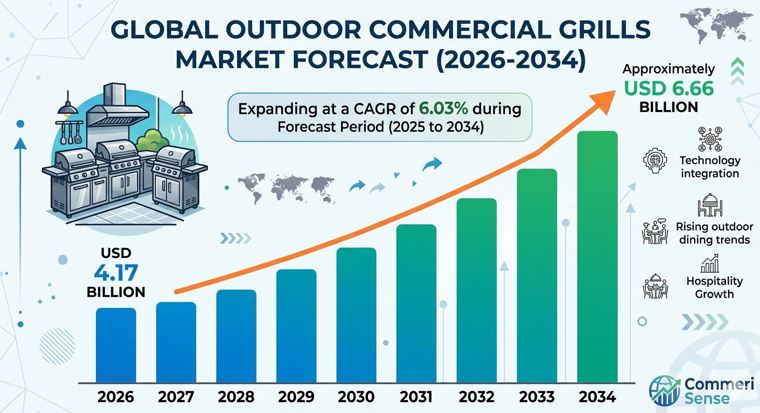
Global outdoor commercial grills market size USD 4.17 billion in 2026 to approximately USD 6.66 billion by 2034, expanding at a CAGR of 6.03% during forecast period 2025 to 2034.
The global outdoor commercial grills market has witnessed substantial growth in recent years due to the increasing popularity of outdoor dining, rising demand for grilled food products, and the expansion of the hospitality and foodservice industries worldwide. Outdoor commercial grills are specialized cooking equipment designed for high-volume grilling applications in restaurants, hotels, catering services, food trucks, resorts, recreational facilities, and outdoor event venues. These grills are built to withstand continuous usage while delivering efficient cooking performance, durability, and consistent food quality.
The growing global trend toward outdoor entertainment and dining experiences has played a major role in driving market demand. Restaurants and hospitality businesses are increasingly investing in outdoor seating arrangements and open-air cooking facilities to enhance customer experiences. Outdoor grilling has become an essential feature in restaurants, rooftop cafes, resorts, and recreational venues, particularly in regions with favorable weather conditions. Consumers are increasingly attracted to live cooking experiences, barbecue-themed dining, and smoke-flavored food preparations, which has encouraged businesses to adopt advanced commercial grilling systems.
The increasing popularity of grilled food items among consumers is another significant factor contributing to market growth. Grilled meat, seafood, vegetables, and plant-based food products are widely perceived as flavorful and healthier alternatives to fried foods. Growing consumer preference for high-protein diets, smoked flavors, and flame-cooked meals has increased demand for outdoor commercial grills across the foodservice sector. Quick-service restaurants, barbecue chains, and street food vendors are continuously expanding their grilling capabilities to meet evolving customer preferences.
Technological advancements in outdoor commercial grill equipment are also transforming the market landscape. Manufacturers are developing innovative grills with enhanced fuel efficiency, temperature control systems, smart monitoring features, and energy-saving capabilities. Modern commercial grills are designed with stainless steel construction, infrared heating technologies, automated ignition systems, and multi-zone cooking functionalities to improve operational efficiency and cooking consistency. Smart grills integrated with digital controls and remote monitoring systems are gaining popularity among commercial kitchens seeking improved productivity and precision cooking.
The market is also benefiting from the rapid expansion of the hospitality and tourism sectors globally. Hotels, resorts, amusement parks, cruise ships, and recreational facilities are increasingly incorporating outdoor dining and barbecue services to attract tourists and improve guest experiences. The rise of food festivals, outdoor catering events, and mobile food businesses has further accelerated demand for portable and high-performance commercial grilling equipment. In addition, the growth of sports stadiums, entertainment complexes, and event venues has increased the need for durable outdoor cooking systems capable of serving large crowds efficiently.
Based on fuel type, the outdoor commercial grills market includes gas grills, charcoal grills, electric grills, wood pellet grills, and hybrid grills. Gas grills dominate the market due to their convenience, fast heating capabilities, and ease of operation. These grills are widely used in restaurants and commercial establishments that require quick and consistent cooking performance. Charcoal grills continue to maintain strong demand because they provide traditional smoky flavors preferred in barbecue cooking. Meanwhile, wood pellet and hybrid grills are gaining popularity among premium foodservice providers seeking enhanced flavor control and energy efficiency.
The increasing focus on sustainability and environmentally friendly cooking solutions is another important trend shaping the market. Manufacturers are introducing eco-friendly grill models designed to reduce carbon emissions, improve fuel efficiency, and minimize energy consumption. Electric grills and pellet-based systems are increasingly being adopted in urban commercial spaces where environmental regulations and air quality standards are becoming stricter. Businesses are also seeking grilling equipment with recyclable materials and low-maintenance designs to reduce operational costs and environmental impact.
North America currently holds a dominant position in the global outdoor commercial grills market due to the strong barbecue culture, high consumer spending on dining experiences, and the presence of established foodservice industries. The United States remains one of the largest markets for commercial grilling equipment, supported by the widespread popularity of outdoor cooking and barbecue restaurants. Europe also represents a significant market share, driven by growing outdoor dining trends and increasing investments in hospitality infrastructure.
The Asia-Pacific region is expected to witness the fastest market growth during the forecast period. Rapid urbanization, expanding tourism industries, rising disposable incomes, and increasing adoption of Western dining trends are driving demand for outdoor commercial grills in countries such as China, India, Japan, South Korea, and Australia. The growing number of restaurants, cafes, and food chains offering grilled menu items is further supporting regional market expansion.
Despite strong growth prospects, the market faces certain challenges including high equipment costs, fluctuating raw material prices, and maintenance requirements associated with commercial grilling systems. Strict safety regulations and environmental compliance standards may also increase operational costs for manufacturers and foodservice providers. However, continuous product innovation, rising outdoor dining preferences, and growing investments in hospitality infrastructure are expected to create favorable opportunities for long-term market growth.
Key Outdoor Commercial Grills Market Dynamics
The global outdoor commercial grills market is shaped by a range of dynamic factors that influence its growth trajectory, demand patterns, and competitive landscape. These dynamics include key drivers, restraints, and emerging trends that collectively determine how the market evolves across regions and end-use industries such as restaurants, hotels, catering services, and outdoor event management.
One of the primary drivers of the outdoor commercial grills market is the rising popularity of outdoor dining experiences. Consumers increasingly prefer open-air restaurants, rooftop cafes, barbecue stations, and live cooking setups that offer an engaging and social dining atmosphere. This shift in consumer behavior has encouraged foodservice providers to invest in advanced outdoor grilling equipment that enhances both food quality and customer experience. The trend is particularly strong in urban areas where lifestyle dining and experiential eating are becoming mainstream.
The growing demand for grilled and smoked food products is another major driver of market growth. Grilled foods are widely perceived as healthier alternatives to fried items, offering lower fat content and richer flavors. Increasing consumer interest in high-protein diets, barbecue cuisine, and flame-cooked meals has significantly boosted the adoption of commercial grills. Restaurants and quick-service food chains are expanding their grilled menu offerings, further increasing the need for high-capacity, durable outdoor grilling systems.
Technological advancements in grilling equipment are also contributing to market expansion. Manufacturers are introducing smart grills with features such as digital temperature control, automated ignition systems, multi-zone cooking, and energy-efficient designs. These innovations help improve cooking precision, reduce operational costs, and enhance safety in commercial kitchens. The integration of IoT-enabled monitoring systems is also emerging, allowing chefs and operators to track cooking performance and equipment efficiency in real time.
However, the market also faces several restraints. High initial investment costs for advanced commercial grilling equipment can be a significant barrier, especially for small and medium-sized foodservice businesses. In addition, maintenance costs and the need for regular servicing can increase the overall operational burden. Fluctuating raw material prices, particularly for stainless steel and fuel components, may also impact manufacturing costs and product pricing.
Environmental regulations present another challenge for the market. Increasing concerns about carbon emissions, air pollution, and energy consumption have led to stricter regulatory standards for commercial cooking equipment in several regions. Businesses using charcoal and gas grills may face compliance requirements that increase operational complexity. As a result, there is growing pressure on manufacturers to develop eco-friendly and energy-efficient grilling solutions.
Despite these challenges, several opportunities are emerging in the market. The expansion of the hospitality and tourism industries is creating strong demand for outdoor commercial grills in hotels, resorts, cruise ships, and recreational venues. Additionally, the rise of food festivals, outdoor catering services, and mobile food trucks is generating new growth avenues for portable and flexible grilling solutions. Emerging economies in Asia-Pacific and Latin America are also offering significant opportunities due to rising disposable incomes and increasing adoption of Western-style dining habits.
Sustainability is another important trend shaping market dynamics. Manufacturers are focusing on developing environmentally friendly grills that use cleaner fuels, reduce smoke emissions, and optimize energy consumption. Electric and pellet-based grills are gaining traction as sustainable alternatives to traditional charcoal systems.
The outdoor commercial grills market is driven by evolving consumer dining preferences, technological innovation, and the expansion of the global foodservice industry. While cost pressures and regulatory challenges persist, continuous innovation and growing demand for outdoor culinary experiences are expected to sustain long-term market growth.
Key Outdoor Commercial Grills Market Restraints
The global outdoor commercial grills market is experiencing steady growth, driven by the rising popularity of outdoor dining and increasing demand from the hospitality and foodservice industries. However, despite these positive trends, the market also faces several restraints that can hinder its expansion. These challenges are related to high costs, operational limitations, regulatory pressures, environmental concerns, and evolving consumer expectations. Understanding these restraints is essential for manufacturers, restaurant operators, and investors aiming to navigate the competitive landscape effectively.
One of the most significant restraints in the outdoor commercial grills market is the high initial investment cost. Advanced commercial grilling systems, especially those equipped with smart technology, energy-efficient features, and durable stainless-steel construction, require substantial capital expenditure. Small and medium-sized foodservice businesses often find it difficult to afford such equipment, particularly when they are already managing tight profit margins. The cost of setting up outdoor cooking infrastructure, including ventilation systems, safety installations, and maintenance support, further increases the overall financial burden.
In addition to high acquisition costs, maintenance and operational expenses also pose a major challenge. Outdoor commercial grills are exposed to environmental conditions such as heat, moisture, dust, and wind, which can accelerate wear and tear. Regular servicing, cleaning, part replacement, and fuel management are necessary to ensure optimal performance and safety. These ongoing expenses can significantly increase the total cost of ownership, making it less attractive for budget-conscious operators.
Another key restraint is the strict regulatory environment governing commercial cooking equipment. Governments and regulatory authorities across various regions have implemented stringent safety, hygiene, and environmental standards for foodservice operations. Outdoor grills, particularly those using charcoal or gas, must comply with emissions regulations, fire safety guidelines, and ventilation requirements. Meeting these standards often requires additional investment in compliance infrastructure and certifications, which can delay product adoption and increase operational complexity for businesses.
Environmental concerns are also becoming a major limiting factor for the market. Traditional outdoor grills that use charcoal and gas contribute to air pollution and greenhouse gas emissions. Increasing global awareness of climate change and sustainability is putting pressure on restaurants and manufacturers to adopt cleaner and more energy-efficient alternatives. In some urban areas, restrictions on open-flame cooking or smoke emissions have already been introduced, limiting the use of certain types of commercial grills. This shift toward environmental responsibility may reduce demand for conventional grilling systems in the long term.
Space limitations in urban commercial settings also act as a restraint on market growth. Many restaurants, especially in densely populated cities, face challenges in allocating sufficient outdoor space for large grilling equipment. Real estate costs are high, and businesses often prioritize indoor seating capacity over outdoor installations. As a result, the adoption of outdoor commercial grills may be limited to establishments with adequate space or those located in suburban and tourist-friendly areas.
Another challenge is the dependency on skilled labor for operating and managing commercial grills. Proper use of outdoor grilling equipment requires trained chefs and kitchen staff who understand temperature control, cooking techniques, and safety procedures. However, there is a shortage of skilled culinary professionals in many regions, which can affect operational efficiency and food quality. Inexperienced handling of grilling equipment can also lead to safety risks and inconsistent food preparation outcomes.
Seasonality is another important restraint affecting the outdoor commercial grills market. In regions with extreme weather conditions such as heavy rainfall, snowfall, or high humidity, outdoor dining and grilling activities tend to decline during certain periods of the year. This seasonal fluctuation impacts revenue generation for restaurants and reduces the consistent utilization of outdoor grilling equipment. Businesses operating in such regions may hesitate to invest heavily in outdoor infrastructure due to uncertain year-round demand.
Furthermore, competition from alternative cooking technologies poses a challenge to market growth. Indoor kitchen equipment such as high-efficiency ovens, induction cooktops, and automated cooking systems can replicate grilled flavors using advanced techniques. These alternatives often offer greater convenience, safety, and consistency, making them attractive options for some foodservice operators. As technology continues to evolve, the demand for traditional outdoor grilling methods may face additional pressure.
Supply chain disruptions and fluctuating raw material prices also affect the market. The production of commercial grills depends heavily on metals such as stainless steel and iron, as well as electronic components for advanced systems. Any instability in global supply chains or price volatility in raw materials can increase manufacturing costs and impact product pricing. This, in turn, may reduce affordability for end users and slow down market adoption.
| Report Coverage | Details |
|---|---|
| Market Size in 2024 | USD 3.72 Billion |
| Market Size in 2025 | USD 3.93 Billion |
| Market Size in 2026 | USD 4.17 Billion |
| Market Size by 2034 | USD 6.66 Billion |
| Market Growth Rate (2025–2034) | CAGR of 6.03% |
| Dominating Region | North America |
| Fastest Growing Region | Asia Pacific |
| Base Year | 2024 |
| Forecast Period | 2025 to 2034 |
Outdoor Commercial Grills Market Opportunities
The global outdoor commercial grills market is witnessing strong growth potential driven by evolving consumer dining preferences, rapid expansion of the hospitality industry, and increasing adoption of outdoor and experiential eating concepts. As foodservice providers continue to innovate and differentiate their offerings, numerous opportunities are emerging for manufacturers, suppliers, and investors in this space. These opportunities are shaped by technological advancements, changing lifestyle patterns, and the growing emphasis on premium dining experiences.
One of the most prominent opportunities in the market is the rising demand for outdoor dining experiences. Consumers today are increasingly drawn to restaurants, cafes, and hospitality venues that offer open-air seating, live cooking stations, and barbecue-style dining environments. This shift toward experiential dining is encouraging foodservice operators to invest in advanced outdoor commercial grilling systems that enhance ambiance and customer engagement. Establishments that integrate outdoor grills into their service offerings are able to attract more customers, increase dwell time, and improve overall revenue generation.
The expansion of the global hospitality and tourism industry also presents significant growth opportunities for the outdoor commercial grills market. Hotels, resorts, cruise ships, amusement parks, and recreational destinations are increasingly incorporating outdoor grilling facilities to enhance guest experiences. Tourists often seek unique culinary experiences during travel, and live grilling stations or barbecue-themed events have become a key attraction. This trend is especially strong in tourist-heavy regions where outdoor dining is feasible year-round, creating consistent demand for commercial grilling equipment.
Another major opportunity lies in the growing popularity of food festivals, outdoor catering services, and pop-up dining events. These formats rely heavily on portable and efficient grilling equipment that can be quickly set up and operated in outdoor environments. Event-based dining is becoming increasingly popular in urban centers, where consumers are looking for unique and social food experiences. This trend is driving demand for compact, mobile, and energy-efficient commercial grills that can be used across various event settings.
Technological innovation is creating substantial opportunities for market expansion. Manufacturers are developing advanced grilling systems equipped with digital temperature controls, smart sensors, automated cooking functions, and energy-efficient technologies. The integration of IoT-enabled monitoring systems allows operators to track cooking performance, reduce energy consumption, and improve operational efficiency. These innovations not only enhance food quality and consistency but also help businesses optimize labor and reduce operational costs.
Sustainability is another key area of opportunity in the outdoor commercial grills market. With increasing environmental awareness and stricter emissions regulations, there is growing demand for eco-friendly grilling solutions. Electric grills, pellet-based systems, and hybrid models that reduce smoke emissions and energy consumption are gaining popularity. Manufacturers that focus on developing sustainable products using recyclable materials and clean energy technologies are likely to gain a competitive advantage in the evolving market landscape.
Emerging economies represent a significant growth opportunity for the outdoor commercial grills market. Regions such as Asia-Pacific, Latin America, and parts of the Middle East & Africa are experiencing rapid urbanization, rising disposable incomes, and expanding foodservice industries. As consumers in these regions adopt Western dining habits and seek diverse culinary experiences, demand for grilled and barbecue-style food is increasing. Countries such as India, China, Brazil, Thailand, and the United Arab Emirates are expected to play a major role in future market growth.
The increasing popularity of quick-service restaurants (QSRs) and fast-casual dining formats also presents strong opportunities for market players. These establishments often rely on high-efficiency grilling equipment to serve large volumes of customers quickly while maintaining consistent food quality. Outdoor grills that offer fast cooking times, easy maintenance, and durability are becoming essential for such business models.
Customization and modular equipment design is another emerging opportunity. Foodservice operators are increasingly seeking flexible grilling solutions that can be adapted to different menu offerings and space constraints. Modular grill systems that allow customization based on cooking capacity, fuel type, and configuration are gaining traction. This flexibility helps businesses scale operations efficiently and optimize kitchen layouts.
In addition, the rise of social media and food influencer culture is indirectly boosting demand for visually appealing outdoor grilling setups. Restaurants that offer live grilling experiences and visually engaging food preparation environments are more likely to attract attention online. This trend is encouraging businesses to invest in aesthetically designed outdoor kitchens that enhance brand visibility and customer engagement.
Lastly, the growing demand for premium and gourmet barbecue cuisine is opening new opportunities for specialized outdoor grilling solutions. High-end restaurants and specialty barbecue chains are focusing on delivering unique flavor profiles and authentic grilling experiences. This is driving demand for advanced grills capable of precise temperature control and multi-style cooking techniques.
Outdoor Commercial Grills Market Drivers
The global outdoor commercial grills market is experiencing strong and sustained growth, driven by a combination of evolving consumer dining preferences, expansion of the hospitality industry, and continuous advancements in foodservice equipment technology. As restaurants, hotels, resorts, and catering businesses increasingly focus on delivering unique culinary experiences, outdoor grilling has become a key element of modern commercial food preparation. Several important drivers are contributing to the rising demand for outdoor commercial grills across global markets.
One of the most significant drivers of the outdoor commercial grills market is the growing popularity of outdoor dining experiences. Consumers today are increasingly drawn to open-air restaurants, rooftop lounges, beachside eateries, and garden cafés that offer a relaxed and engaging atmosphere. Outdoor grilling adds a live cooking element that enhances customer experience by providing visual appeal, aroma, and entertainment. This trend toward experiential dining has encouraged foodservice operators to invest in high-performance outdoor grilling systems that elevate ambiance and customer satisfaction.
The rising demand for grilled and barbecue-style food is another major factor fueling market growth. Grilled foods are widely perceived as healthier compared to fried alternatives, as they typically require less oil and retain natural flavors. Increasing awareness of healthy eating habits, combined with the popularity of high-protein diets, has significantly boosted the consumption of grilled meat, seafood, vegetables, and plant-based alternatives. Restaurants and quick-service food chains are expanding their grilled menu offerings to meet this growing consumer demand, thereby driving adoption of commercial grilling equipment.
The expansion of the global hospitality and tourism industry is also a key driver of market growth. Hotels, resorts, cruise ships, amusement parks, and recreational destinations are increasingly incorporating outdoor grilling stations to enhance guest experiences. Tourists often seek unique and memorable dining experiences, and live barbecue or open-flame cooking has become a popular attraction. This has led hospitality operators to invest in durable, high-capacity outdoor grills capable of serving large groups efficiently while maintaining consistent food quality.
Technological advancements in commercial grilling equipment are further accelerating market expansion. Manufacturers are introducing innovative grills equipped with digital temperature controls, automated ignition systems, energy-efficient burners, and multi-zone cooking capabilities. Smart grills integrated with IoT technology allow operators to monitor performance, optimize fuel usage, and maintain consistent cooking results. These innovations improve operational efficiency, reduce labor dependency, and enhance food quality, making advanced grilling systems more attractive to commercial users.
Another important driver is the rapid growth of the foodservice industry, including restaurants, catering services, food trucks, and cloud kitchens. As competition intensifies, businesses are focusing on differentiation through menu innovation and unique dining formats. Outdoor grilling provides a distinctive cooking style that helps restaurants stand out in a crowded market. Food festivals, pop-up events, and outdoor catering services are also increasing demand for portable and efficient grilling solutions that can operate in diverse environments.
Rising disposable incomes and changing lifestyle patterns, particularly in emerging economies, are also contributing to market growth. Consumers in developing regions are spending more on dining out and premium food experiences. Urbanization and the influence of global food trends have led to greater acceptance of barbecue and grilled cuisine. As a result, foodservice providers in these regions are expanding their infrastructure to include outdoor cooking setups, further driving demand for commercial grills.
The increasing focus on sustainability and energy efficiency is also shaping market dynamics. Manufacturers are developing eco-friendly grills that reduce emissions, optimize fuel consumption, and use cleaner energy sources such as electricity and wood pellets. Businesses are increasingly adopting sustainable equipment to comply with environmental regulations and meet consumer expectations for greener operations. This shift is encouraging innovation in low-emission and energy-efficient grilling technologies.
In addition, the growing influence of social media and digital marketing is indirectly driving market growth. Restaurants that offer visually appealing outdoor grilling experiences are more likely to attract attention on platforms such as Instagram, TikTok, and YouTube. Live cooking setups and barbecue displays create engaging content that enhances brand visibility and customer engagement. This has encouraged foodservice operators to invest in aesthetically designed outdoor grilling stations.
Lastly, the expansion of quick-service restaurants (QSRs) and fast-casual dining formats is further supporting market growth. These establishments require efficient, high-capacity cooking equipment that can handle large volumes of customers while maintaining speed and consistency. Outdoor commercial grills meet these requirements by offering fast cooking times, durability, and ease of operation, making them an essential component of modern foodservice operations.
Outdoor Commercial Grills Market Trends
The global outdoor commercial grills market is undergoing notable transformation, driven by shifting consumer dining preferences, technological innovation, and the rapid expansion of the hospitality and foodservice industries. As outdoor dining becomes more mainstream and experiential eating gains popularity, several key trends are shaping the development and adoption of commercial grilling equipment across restaurants, hotels, resorts, and catering businesses worldwide.
One of the most prominent trends in the outdoor commercial grills market is the rising demand for experiential and outdoor dining concepts. Consumers are increasingly seeking dining experiences that go beyond just food consumption. Open-air restaurants, rooftop lounges, garden cafés, and beachside grilling stations are becoming highly popular, as they offer a combination of ambiance, entertainment, and live cooking. Outdoor grills play a central role in these setups by providing visual cooking experiences, smoky flavors, and interactive food preparation that enhance customer engagement and satisfaction.
Another important trend is the growing preference for healthier and grilled food options. Consumers are becoming more health-conscious and are actively choosing grilled, roasted, or flame-cooked foods over deep-fried alternatives. This shift in dietary behavior has led restaurants and quick-service chains to expand their grilled menu offerings, including lean meats, seafood, vegetables, and plant-based alternatives. As a result, demand for efficient and high-performance outdoor commercial grills continues to rise across the foodservice sector.
Technological advancement is also playing a crucial role in shaping market trends. Manufacturers are introducing smart grilling systems equipped with digital temperature controls, automated ignition systems, multi-zone cooking features, and energy-efficient burners. The integration of IoT-enabled monitoring systems allows operators to track cooking performance, manage fuel consumption, and maintain consistent food quality. These innovations are helping commercial kitchens improve productivity, reduce labor dependency, and enhance operational efficiency.
Sustainability and eco-friendly cooking solutions are becoming increasingly important in the outdoor commercial grills market. With growing awareness of environmental issues and stricter emission regulations in several regions, there is a strong shift toward energy-efficient and low-emission grilling technologies. Electric grills, pellet-based systems, and hybrid models are gaining traction as cleaner alternatives to traditional charcoal and gas grills. Manufacturers are also focusing on using recyclable materials and developing products that reduce carbon emissions and fuel consumption.
Leading Key Players in the Outdoor Commercial Grills Market
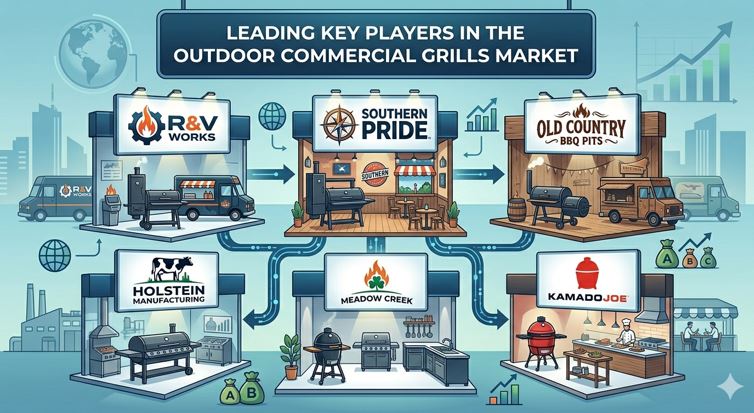
- R&V Works
- Southern Pride
- Old Country BBQ Pits
- Holstein Manufacturing
- Meadow Creek
- Kamado Joe
- Louisiana Grills
- Weber-Stephen Products LLC
- Traeger Pellet Grills LLC
- Napoleon
Outdoor Commercial Grills Market Segmentation
The global outdoor commercial grills market is segmented based on type, application, end-user industry, and geography. This segmentation helps in understanding demand patterns, identifying high-growth areas, and analyzing consumer preferences across different regions and foodservice formats. As the demand for outdoor dining and live cooking experiences continues to rise, each segment plays a significant role in shaping the overall market structure.
By Type Analysis
Based on type, the outdoor commercial grills market is categorized into gas grills, charcoal grills, electric grills, wood pellet grills, and hybrid grills. Among these, gas grills hold the largest market share due to their convenience, quick heating capabilities, and ease of operation. Gas grills are widely used in restaurants, hotels, and catering services because they provide consistent cooking performance and allow precise temperature control. Their efficiency and low maintenance requirements make them highly suitable for high-volume commercial food preparation.
Charcoal grills remain popular due to their ability to impart a traditional smoky flavor that is highly preferred in barbecue cuisine. Many specialty restaurants and barbecue joints continue to rely on charcoal grills to deliver authentic taste experiences. Although they require longer cooking times and more manual effort, their flavor profile keeps them in strong demand, especially in regions with established barbecue traditions.
Electric grills are gaining traction in urban and indoor-adjacent outdoor settings where open flames may be restricted. These grills offer clean operation, ease of use, and better compliance with environmental regulations. They are particularly useful in areas with strict emission norms or limited outdoor ventilation options. While their market share is relatively smaller, steady growth is expected as sustainability concerns increase.
Wood pellet grills represent a growing segment due to their combination of convenience and flavor enhancement. These grills use compressed wood pellets as fuel, offering a balance between gas efficiency and charcoal-like flavor. They are increasingly being adopted in premium restaurants and modern barbecue setups where chefs seek enhanced flavor control and consistency.
Hybrid grills, which combine multiple fuel sources or cooking methods, are also emerging as a versatile solution for commercial kitchens. These grills allow operators to switch between gas, charcoal, or electric modes depending on cooking requirements. This flexibility makes them attractive for businesses that aim to offer diverse menu options and cooking styles.
By Application Analysis
Based on application, the outdoor commercial grills market is segmented into restaurants, hotels and resorts, catering services, food trucks, event management companies, and others. Restaurants represent the largest application segment due to the widespread adoption of outdoor dining concepts and live grilling stations. Many restaurants are incorporating open kitchens and barbecue setups to enhance customer engagement and differentiate themselves from competitors.
Hotels and resorts are another major application segment, driven by the growing demand for luxury dining experiences. Many high-end hospitality establishments offer outdoor barbecue nights, poolside grilling stations, and themed dining events to attract guests. These setups require durable, high-capacity grills capable of serving large groups efficiently.
Catering services also contribute significantly to market demand. Outdoor grills are essential for large-scale events such as weddings, corporate gatherings, festivals, and private parties. Portable and easy-to-operate grills are particularly popular in this segment due to their mobility and quick setup features.
Food trucks and mobile food vendors are emerging as a fast-growing application segment. These businesses rely heavily on compact and efficient grilling equipment to serve freshly cooked food in outdoor environments. The increasing popularity of street food culture and on-the-go dining has boosted demand for portable commercial grills.
Event management companies utilize outdoor grills for concerts, sports events, exhibitions, and food festivals. These grills help in delivering large quantities of food quickly while maintaining quality and flavor consistency. The flexibility and scalability of commercial grilling equipment make them ideal for temporary event setups.
Geographical Analysis of Outdoor Commercial Grills Market
The global outdoor commercial grills market is segmented into North America, Europe, Asia-Pacific, Latin America, and the Middle East & Africa. Each region exhibits unique growth drivers based on consumer behavior, cultural preferences, economic conditions, and hospitality industry development.
North America dominates the global market due to the strong barbecue culture, high disposable income levels, and well-established foodservice industry. The United States, in particular, is a major contributor, with widespread adoption of outdoor grilling in restaurants, hotels, and residential-commercial hybrid spaces. The popularity of barbecue cuisine and outdoor dining experiences continues to support regional growth.
Europe holds a significant market share, driven by increasing demand for outdoor dining and premium culinary experiences. Countries such as Germany, the United Kingdom, France, and Italy are witnessing growing adoption of outdoor grilling in restaurants and hospitality venues. Sustainability trends and strict environmental regulations are also encouraging the use of energy-efficient grilling equipment in the region.
Asia-Pacific is expected to witness the fastest growth during the forecast period. Rapid urbanization, rising disposable incomes, and the expansion of the hospitality sector are key growth drivers. Countries like China, India, Japan, South Korea, and Australia are experiencing increasing demand for outdoor dining experiences and Western-style barbecue cuisine. The region’s growing tourism industry further supports market expansion.
Latin America is also emerging as a promising market, particularly in countries such as Brazil and Mexico, where barbecue culture is deeply rooted. Rising tourism and growing interest in outdoor social dining are contributing to increased adoption of commercial grills.
The Middle East & Africa region is witnessing steady growth due to expanding hospitality infrastructure and rising investments in tourism projects. Countries such as the UAE and Saudi Arabia are focusing on luxury dining experiences, including outdoor barbecue setups in hotels and resorts.
FAQ
What are outdoor commercial grills used for?
Outdoor commercial grills are used in restaurants, hotels, catering services, and outdoor events to cook food at high volumes. They are commonly used for grilling meat, seafood, vegetables, and barbecue-style dishes while providing live cooking experiences for customers.
Which type of outdoor commercial grill is most popular?
Gas grills are the most popular type of outdoor commercial grills due to their fast heating, ease of use, and consistent cooking performance. However, charcoal grills remain widely used for their traditional smoky flavor, especially in barbecue-focused restaurants.
What factors are driving the growth of the outdoor commercial grills market?
The market is driven by rising demand for outdoor dining experiences, increasing popularity of grilled and healthy food options, expansion of the hospitality industry, and technological advancements in grilling equipment such as smart and energy-efficient grills.
Which regions are leading the outdoor commercial grills market?
North America currently leads the market due to strong barbecue culture and a developed foodservice industry. However, Asia-Pacific is expected to grow the fastest due to rising urbanization, tourism, and increasing adoption of outdoor dining concepts.
What are the key challenges in the outdoor commercial grills market?
Key challenges include high equipment and maintenance costs, strict environmental regulations, space limitations in urban areas, seasonal demand fluctuations, and the need for skilled operators to manage commercial grilling equipment effectively.
