
Global Household Induction Cooktops Market Introduction
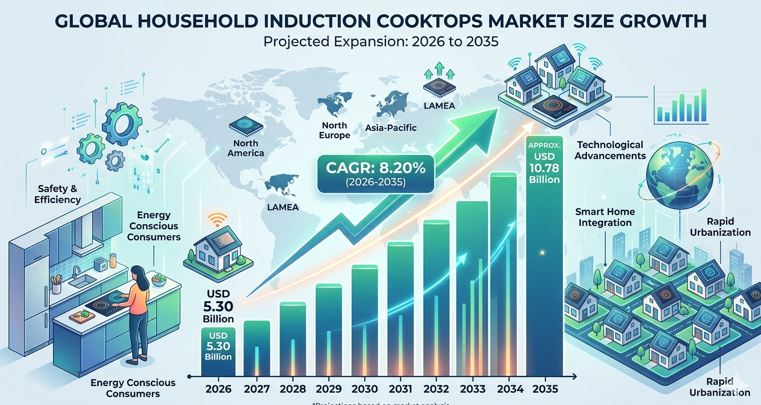
The global household induction cooktops market size is predicted to increase from USD 5.30 billion in 2026 to approximately USD 10.78 billion by 2035, expanding at a CAGR of 8.20% from 2026 to 2035.
The global household induction cooktops market has experienced significant growth in recent years due to changing consumer lifestyles, increasing urbanization, and rising demand for energy-efficient kitchen appliances. Household induction cooktops are modern cooking devices that use electromagnetic energy to directly heat cookware, offering faster cooking performance, improved safety, and enhanced energy efficiency compared to traditional gas stoves and electric cookers. As consumers increasingly prioritize convenience, sustainability, and smart home technologies, induction cooktops have become an essential component of modern residential kitchens worldwide.
One of the major factors driving the growth of the household induction cooktops market is the increasing awareness regarding energy conservation and environmentally friendly appliances. Induction cooktops are highly energy-efficient because they transfer heat directly to cookware instead of heating the surrounding air or cooking surface. This reduces energy wastage and shortens cooking time, making induction technology more efficient than conventional cooking methods. Governments and environmental organizations across several countries are promoting energy-efficient household appliances to reduce carbon emissions and support sustainable living practices, which is positively influencing market growth.
Rapid urbanization and changing lifestyles are also contributing significantly to market expansion. As urban populations continue to rise, consumers are increasingly adopting compact, modern, and multifunctional kitchen appliances that fit contemporary living spaces. Household induction cooktops are especially popular in urban apartments and small homes due to their sleek design, portability, and ease of installation. In addition, the growing number of working professionals and dual-income households has increased demand for appliances that offer quick cooking and user convenience.
Technological advancements have played a major role in shaping the global household induction cooktops market. Manufacturers are continuously introducing innovative products equipped with advanced features such as touch-screen controls, temperature sensors, automatic shut-off systems, timer settings, child safety locks, and smart connectivity functions. Some premium induction cooktops are integrated with Internet of Things (IoT) technology, allowing users to control cooking settings remotely through smartphones and smart home systems. These technological improvements are enhancing user experience and increasing consumer interest in induction cooking appliances.
The increasing focus on kitchen safety is another important factor supporting market growth. Unlike traditional gas stoves, induction cooktops do not use open flames, reducing the risk of fire accidents and gas leaks. The cooking surface remains relatively cool during operation because heat is generated directly inside the cookware, minimizing the risk of burns and improving household safety. These safety benefits make induction cooktops highly attractive for families with children and elderly individuals.
Growing disposable incomes and improving living standards are further boosting market demand, particularly in developing economies. Consumers are increasingly willing to invest in premium and technologically advanced kitchen appliances that improve comfort and efficiency. The expansion of the middle-class population in countries such as China, India, Brazil, and Southeast Asian nations has significantly contributed to the adoption of household induction cooktops.
Geographically, Asia-Pacific dominates the global household induction cooktops market due to rapid urbanization, rising consumer spending, and increasing adoption of modern kitchen appliances. Countries such as China, Japan, South Korea, and India represent major growth markets in the region. Europe and North America also hold substantial market shares due to strong awareness regarding energy efficiency and the growing popularity of smart home technologies.
Despite strong growth potential, the market faces certain challenges. High initial product costs compared to traditional cooking appliances and the requirement for induction-compatible cookware may limit adoption among price-sensitive consumers. In some regions, limited awareness and preference for traditional cooking methods may also restrain market growth.
The global household induction cooktops market is expected to witness steady expansion in the coming years due to increasing energy efficiency awareness, technological advancements, urban lifestyle changes, and growing demand for safe and convenient cooking solutions. As manufacturers continue to innovate and consumer preferences evolve toward modern kitchen technologies, induction cooktops are likely to become an increasingly important segment of the global household appliance industry.
Key Household Induction Cooktops Market Dynamics
The global household induction cooktops market is influenced by several dynamic factors that shape its growth, consumer demand, competitive environment, and future development. These market dynamics include drivers, restraints, opportunities, technological advancements, and changing consumer preferences that collectively impact the expansion of the industry. Rising awareness regarding energy efficiency, increasing urbanization, and the growing adoption of modern kitchen appliances are among the key factors contributing to the growth of the household induction cooktops market worldwide.
One of the primary drivers of the market is the increasing consumer demand for energy-efficient cooking appliances. Induction cooktops consume less energy compared to traditional gas stoves and electric cookers because they directly heat cookware through electromagnetic induction. This reduces heat loss and improves cooking efficiency, helping households lower electricity consumption and cooking time. Growing concerns regarding energy conservation and environmental sustainability are encouraging consumers to adopt energy-saving appliances, positively influencing market growth.
Rapid urbanization and changing lifestyles are also major market drivers. Urban consumers increasingly prefer compact, portable, and technologically advanced kitchen appliances that align with modern living standards. Household induction cooktops are gaining popularity in apartments and smaller homes due to their sleek design, easy maintenance, and space-saving features. In addition, the increasing number of working professionals and dual-income households has created higher demand for convenient and time-saving cooking solutions.
Technological innovation plays a significant role in shaping market dynamics. Manufacturers are continuously introducing advanced induction cooktops equipped with features such as touch controls, smart sensors, digital displays, automatic shut-off systems, temperature control settings, and child safety locks. The integration of smart technologies and Internet of Things (IoT) capabilities is further enhancing product appeal by allowing users to monitor and control cooking appliances remotely through smartphones and smart home systems. These innovations are improving user experience and driving consumer interest in premium induction cooktop models.
The growing emphasis on household safety is another important factor supporting market expansion. Unlike traditional gas stoves, induction cooktops do not use open flames, reducing the risks associated with gas leakage, fire accidents, and burns. Since the cooking surface remains relatively cool during operation, induction technology is considered safer for households with children and elderly family members. This increased focus on safety is encouraging more consumers to shift toward induction-based cooking appliances.
Despite positive growth prospects, the market also faces certain restraints. One major challenge is the relatively high initial cost of induction cooktops compared to conventional gas stoves or electric cooking appliances. Price-sensitive consumers, particularly in developing economies, may hesitate to invest in induction technology due to budget limitations. Additionally, induction cooktops require compatible cookware made from ferromagnetic materials, which may increase additional household expenses for consumers transitioning from traditional cooking systems.
Another restraint is the continued preference for traditional cooking methods in certain regions. In many developing countries, consumers remain attached to gas-based cooking because of familiarity, cooking habits, and infrastructure availability. Limited awareness regarding the long-term benefits of induction cooking may also slow market penetration in rural and semi-urban areas.
However, the market presents strong opportunities for future growth. Rising disposable incomes, increasing smart home adoption, and expanding e-commerce platforms are expected to create favorable market conditions. Online retail channels are helping manufacturers reach wider customer bases while providing product comparisons, customer reviews, and promotional offers that encourage purchasing decisions.
The global household induction cooktops market is expected to witness steady growth driven by increasing energy efficiency awareness, technological advancements, urban lifestyle changes, and demand for safer and more convenient kitchen appliances. As manufacturers continue innovating and consumers increasingly adopt modern cooking technologies, the market is likely to expand significantly across developed and emerging economies.
Key Household Induction Cooktops Market Restraints
The global household induction cooktops market, despite its strong growth trajectory, faces several restraints that may limit its widespread adoption and slow down market expansion in certain regions. These restraints are primarily related to cost barriers, infrastructure limitations, consumer behavior, compatibility issues, and competition from traditional cooking methods. Understanding these challenges is essential for manufacturers and stakeholders aiming to strengthen market penetration and improve product accessibility.
One of the major restraints in the household induction cooktops market is the high initial cost compared to conventional cooking appliances. Induction cooktops are equipped with advanced electromagnetic technology and digital features, which make them more expensive than traditional gas stoves or basic electric cookers. In price-sensitive markets, particularly in developing countries, many consumers may hesitate to invest in induction cooktops due to budget constraints. This cost factor remains a significant barrier to mass adoption, especially among middle- and low-income households.
Another important restraint is the requirement for induction-compatible cookware. Induction cooktops work only with pots and pans made from ferromagnetic materials such as cast iron or stainless steel. Consumers who already own traditional aluminum or copper cookware may need to purchase new utensils, which increases the overall cost of switching to induction cooking. This additional expense can discourage potential buyers and slow down the transition from conventional cooking systems.
Limited awareness and familiarity with induction cooking technology also restrict market growth. In many developing and rural regions, consumers are more accustomed to gas-based cooking methods that have been used for generations. Lack of awareness regarding the benefits of induction cooktops—such as energy efficiency, safety, and faster cooking—reduces adoption rates. Without proper education and marketing initiatives, consumers may be reluctant to switch from traditional cooking systems to modern induction technology.
Infrastructure limitations, particularly in areas with unreliable electricity supply, further hinder market expansion. Induction cooktops depend entirely on electricity to function, making them unsuitable for regions with frequent power outages or unstable electricity networks. In such areas, gas stoves remain a more practical and reliable cooking solution. This dependence on electricity limits the market potential in several developing economies.
Cultural preferences and cooking habits also act as a restraint in the household induction cooktops market. In many regions, traditional cooking methods involving gas flames are deeply ingrained in daily life and culinary practices. Consumers often prefer flame-based cooking because it is associated with taste, control, and familiarity. This cultural preference can slow down the acceptance of induction cooking technology, even when consumers are aware of its benefits.
Additionally, competition from alternative cooking appliances presents a challenge for market growth. Gas stoves, microwave ovens, and advanced electric cookers continue to dominate the kitchen appliance market in many regions. Gas stoves, in particular, remain widely used due to their lower upfront cost and ease of use. This strong competition limits the market share of induction cooktops, especially in households that prioritize affordability over energy efficiency.
Maintenance and repair concerns can also act as minor restraints. Induction cooktops contain electronic components that may require specialized servicing in case of malfunction. In regions with limited technical support infrastructure, repair and maintenance services may not be easily accessible, which can discourage consumers from adopting the technology.
Household Induction Cooktops Market Opportunities
The global household induction cooktops market is poised for strong growth, supported by evolving consumer preferences, rapid urbanization, technological innovation, and increasing demand for energy-efficient kitchen appliances. While the market already shows steady expansion, several emerging opportunities are expected to further accelerate adoption across both developed and developing regions. These opportunities are being shaped by advancements in smart home technology, rising disposable incomes, expanding retail channels, and increasing awareness of sustainable living.
One of the most significant opportunities in the household induction cooktops market is the growing global focus on energy efficiency and environmental sustainability. Governments and environmental agencies are increasingly promoting the use of energy-saving appliances to reduce electricity consumption and carbon emissions. Induction cooktops are highly efficient because they directly heat cookware using electromagnetic induction, minimizing energy loss. As sustainability becomes a key priority for households, manufacturers have the opportunity to position induction cooktops as eco-friendly alternatives to traditional gas stoves and electric cookers.
The rapid expansion of smart homes and connected kitchen appliances also presents a major growth opportunity. Consumers are increasingly adopting smart home ecosystems that include IoT-enabled appliances for convenience and automation. Modern induction cooktops with digital controls, Wi-Fi connectivity, voice assistant compatibility, and mobile app integration are gaining popularity among tech-savvy users. Manufacturers investing in smart and AI-enabled cooking technologies can tap into the growing demand for connected kitchen solutions and premium appliances.
Another important opportunity lies in the increasing urban population and shrinking living spaces. Urbanization has led to a rise in compact apartments and modern housing structures, where space-saving kitchen appliances are in high demand. Induction cooktops, with their sleek and portable designs, are ideal for small kitchens and modular homes. This makes them particularly attractive to urban consumers, students, and working professionals who require efficient and compact cooking solutions.
Rising disposable incomes, especially in emerging economies, are further expanding market opportunities. Countries across Asia-Pacific, Latin America, and parts of Africa are witnessing a growing middle-class population with higher purchasing power. These consumers are gradually shifting toward modern kitchen appliances that offer convenience, safety, and energy efficiency. As affordability improves, induction cooktops are expected to gain wider acceptance in these regions.
The expansion of e-commerce and online retail platforms is another key opportunity for market players. Online channels allow manufacturers to reach a broader customer base, including consumers in remote and underserved regions. Digital platforms also enable product comparisons, customer reviews, discounts, and promotional campaigns, which help increase product visibility and boost sales. Brands that effectively utilize digital marketing and online distribution strategies can significantly enhance their market reach.
Product innovation and customization also present strong opportunities in this market. Manufacturers are increasingly focusing on developing induction cooktops with advanced features such as multi-cooking modes, child safety locks, energy monitoring systems, and durable ceramic glass surfaces. There is also growing demand for portable induction cooktops that can be used for travel, dormitories, and outdoor cooking. Expanding product portfolios to cater to different consumer segments can help companies strengthen their competitive position.
Additionally, increasing awareness of kitchen safety is driving demand for induction technology. Since induction cooktops do not use open flames and remain relatively cool during operation, they significantly reduce the risk of fire accidents and burns. This safety advantage is particularly appealing to families with children and elderly individuals.
Household Induction Cooktops Market Drivers
The global household induction cooktops market is experiencing strong growth due to several key drivers that are reshaping modern cooking habits and accelerating the adoption of energy-efficient kitchen appliances. Increasing consumer awareness of energy conservation, rapid urbanization, technological advancements, and a growing preference for safe and convenient cooking solutions are among the primary factors driving market expansion. These drivers collectively support the shift from traditional gas-based cooking systems to modern induction technology in households worldwide.
One of the most significant drivers of the household induction cooktops market is the rising demand for energy-efficient appliances. Induction cooktops are highly efficient because they use electromagnetic energy to directly heat cookware, resulting in minimal heat loss compared to gas stoves and conventional electric cookers. This efficiency helps reduce electricity consumption and shortens cooking time, making induction cooktops an attractive option for environmentally conscious consumers. With increasing global focus on sustainability and energy savings, households are actively seeking appliances that help reduce utility costs and environmental impact.
Rapid urbanization and changing lifestyles are also major factors fueling market growth. As more people migrate to urban areas, there is a growing demand for compact, modern, and easy-to-use kitchen appliances. Induction cooktops are particularly well-suited for urban households due to their sleek design, portability, and space-saving features. In addition, the rise in dual-income households and busy work schedules has increased the need for quick and efficient cooking solutions, further boosting the adoption of induction-based cooking systems.
Technological advancements in kitchen appliances are another key driver of the market. Manufacturers are continuously innovating by integrating advanced features such as touch controls, temperature sensors, preset cooking modes, automatic shut-off systems, and digital displays. The introduction of smart induction cooktops with Internet of Things (IoT) connectivity has further enhanced user convenience, allowing remote monitoring and control through smartphones or smart home systems. These innovations are making induction cooktops more appealing to tech-savvy consumers and driving demand for premium models.
Safety concerns are also playing a crucial role in the increasing adoption of induction cooktops. Unlike traditional gas stoves, induction cooktops do not use open flames, significantly reducing the risk of fire accidents and gas leaks. Additionally, the cooktop surface remains relatively cool during operation, minimizing the risk of burns. These safety features make induction cooktops especially popular among families with children and elderly members, further contributing to market growth.
Rising disposable incomes and improving living standards, particularly in developing economies, are also driving demand for modern kitchen appliances. As consumers gain greater purchasing power, they are more willing to invest in advanced and energy-efficient cooking technologies that offer long-term benefits. This trend is especially visible in emerging markets where the middle-class population is expanding rapidly.
Government initiatives promoting energy efficiency and sustainable living are further supporting market growth. Many countries are encouraging the adoption of energy-saving appliances through awareness campaigns, subsidies, and regulatory policies. These initiatives are helping to increase consumer awareness of the benefits of induction cooking and accelerating market penetration.
Additionally, the expansion of retail channels and e-commerce platforms has made induction cooktops more accessible to consumers. Online marketplaces allow customers to compare products, read reviews, and access a wider range of options, making purchasing decisions easier and more informed.
Household Induction Cooktops Market Trends
The global household induction cooktops market is evolving rapidly, driven by shifting consumer preferences, technological innovation, and increasing awareness of energy-efficient and safe cooking solutions. As modern households continue to embrace smart appliances and sustainable living practices, several key trends are shaping the growth and development of the induction cooktops industry. These trends highlight how manufacturers are adapting to changing lifestyles and how consumers are redefining kitchen convenience.
One of the most prominent trends in the market is the rising adoption of smart and connected induction cooktops. With the rapid growth of smart home ecosystems, consumers are increasingly seeking appliances that can be integrated with digital platforms. Modern induction cooktops now come with features such as Wi-Fi connectivity, mobile app control, voice assistant compatibility, and programmable cooking modes. These innovations allow users to monitor and control cooking remotely, enhancing convenience and precision. The integration of Internet of Things (IoT) technology is transforming induction cooktops into intelligent kitchen devices.
Another important trend is the growing preference for compact and portable induction cooktops. Urbanization has led to smaller living spaces, especially in metropolitan cities, where kitchen space is limited. As a result, consumers are opting for lightweight, portable, and space-saving cooking solutions. Portable induction cooktops are also gaining popularity among students, renters, and travelers due to their flexibility and ease of use. This trend is encouraging manufacturers to design more compact models without compromising on performance and efficiency.
Energy efficiency and sustainability continue to be central trends driving market growth. Consumers are increasingly aware of the environmental impact of household appliances and are shifting toward energy-saving alternatives. Induction cooktops are highly efficient as they directly transfer heat to cookware, reducing energy loss and cooking time. This aligns with global sustainability goals and government initiatives promoting eco-friendly appliances. As energy costs continue to rise, demand for efficient cooking solutions is expected to grow further.
Safety-focused appliance design is another key trend shaping the market. Induction cooktops eliminate the need for open flames, significantly reducing the risk of fire hazards and gas leaks. Additionally, many models include advanced safety features such as child lock systems, automatic shut-off functions, and overheating protection. These enhancements are making induction cooktops increasingly popular among families, especially those with children and elderly members.
The demand for premium and aesthetically designed kitchen appliances is also on the rise. Consumers are increasingly viewing kitchens as modern living spaces, leading to a preference for stylish and visually appealing appliances. Manufacturers are responding by offering induction cooktops with sleek glass surfaces, touch controls, and minimalistic designs that complement contemporary kitchen interiors. This trend is particularly strong in urban and high-income consumer segments.
Another significant trend is the expansion of online retail and digital marketing channels. E-commerce platforms have made it easier for consumers to compare different models, read customer reviews, and access a wide range of products. Manufacturers are also leveraging social media, influencer marketing, and digital campaigns to increase product visibility and educate consumers about the benefits of induction cooking.
In addition, product innovation and customization are becoming increasingly important. Companies are introducing multi-functional induction cooktops with features such as preset cooking programs, energy monitoring systems, and dual-zone cooking capabilities. Portable and travel-friendly models are also gaining traction in niche markets.
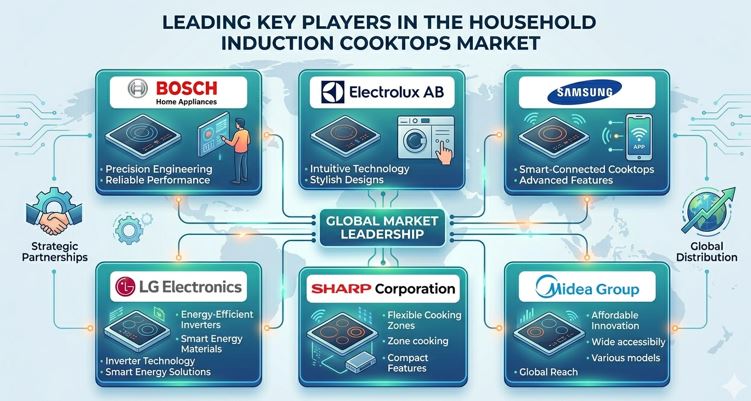
Leading Key Players in the Household Induction Cooktops Market
- Bosch Home Appliances
- Electrolux AB
- Samsung Electronics Co., Ltd.
- LG Electronics
- Sharp Corporation
- Midea Group
- Siemens AG
- Kenmore (Sears)
- Tata Group (Tefal)
- Breville Group
- Miele & Cie. KG
Household Induction Cooktops Market Segmentation
The global household induction cooktops market is segmented based on type, application, and geography. These segments provide a clear understanding of consumer preferences, product diversity, and regional demand patterns shaping the industry. Increasing urbanization, rising disposable incomes, and growing awareness of energy-efficient cooking solutions are driving the expansion of different market segments. Manufacturers are focusing on product innovation and customization to meet the evolving requirements of modern households across various regions.
By Type Analysis
Based on type, the household induction cooktops market is segmented into built-in induction cooktops and portable induction cooktops. Each category caters to different consumer needs based on kitchen space, lifestyle preferences, and budget considerations.
The built-in induction cooktops segment holds a significant share of the market due to its growing popularity in modern residential kitchens. Built-in cooktops are integrated into kitchen countertops, offering a sleek, stylish, and permanent cooking solution. They are commonly used in urban homes, apartments, and premium residential spaces where kitchen design and aesthetics play an important role. These cooktops provide advanced features such as touch controls, multiple cooking zones, precise temperature control, and enhanced safety functions. The increasing trend of modular kitchens and home renovation activities is further boosting demand for built-in induction cooktops, especially in developed regions.
The portable induction cooktops segment is also experiencing strong growth due to its flexibility, affordability, and ease of use. Portable cooktops are lightweight and can be easily moved or stored, making them ideal for small apartments, dormitories, rental homes, and temporary cooking setups. They are particularly popular among students, working professionals, and travelers who require convenient cooking solutions. Portable induction cooktops are also widely used as secondary cooking appliances in households. Their lower cost compared to built-in models makes them more accessible to price-sensitive consumers, especially in developing economies.
Both segments are benefiting from increasing awareness of energy-efficient cooking technologies. While built-in cooktops are preferred for long-term kitchen installations and premium households, portable models are gaining traction due to their versatility and affordability. Manufacturers are focusing on improving durability, energy efficiency, and design aesthetics across both categories to enhance user experience and expand their consumer base.
By Application Analysis
Based on application, the household induction cooktops market is segmented into residential households, rental accommodations, student housing, and hospitality-based residential facilities. The residential household segment dominates the market due to the widespread adoption of induction cooktops in everyday cooking activities.
Residential households are the largest end-user segment as consumers increasingly prefer modern, safe, and energy-efficient cooking appliances. Growing urbanization and rising disposable incomes have encouraged homeowners to invest in advanced kitchen technologies that offer convenience and time savings. Induction cooktops are widely used in family kitchens due to their fast cooking capabilities, safety features, and easy maintenance. The increasing trend of smart homes is further boosting adoption in residential settings.
The rental accommodation segment is also growing steadily due to the rising number of people living in rented apartments in urban areas. Tenants often prefer portable induction cooktops because they are affordable, easy to install, and do not require permanent kitchen modifications. Their portability makes them ideal for temporary living arrangements.
The student housing segment represents another important application area. Students living in hostels, dormitories, and shared accommodations prefer induction cooktops due to their compact size, safety features, and ease of use. These appliances provide a convenient cooking solution in spaces where traditional gas connections may not be available.
Hospitality-based residential facilities, including serviced apartments and guest houses, also contribute to market demand. These establishments often provide induction cooktops in individual units to offer guests a modern and convenient cooking experience. The growing trend of extended-stay accommodations is further supporting demand in this segment.
Geographical Analysis of Household Induction Cooktops Market
Geographically, the global household induction cooktops market is segmented into Asia-Pacific, North America, Europe, Latin America, and the Middle East & Africa. Each region exhibits distinct growth patterns based on consumer preferences, economic conditions, and technological adoption rates.
Asia-Pacific dominates the global market due to rapid urbanization, population growth, and increasing adoption of modern kitchen appliances. Countries such as China, India, Japan, and South Korea are major contributors to regional growth. Rising disposable incomes and expanding middle-class populations are driving demand for energy-efficient and affordable cooking solutions. Government initiatives promoting clean energy and smart appliances are also supporting market expansion.
North America holds a significant market share due to high consumer awareness regarding energy efficiency and strong adoption of smart home technologies. The United States and Canada are key markets, where consumers prefer technologically advanced and safe kitchen appliances. The presence of leading appliance manufacturers further supports regional growth.
Europe is another important market driven by sustainability initiatives and strict energy efficiency regulations. Countries such as Germany, France, Italy, and the United Kingdom are witnessing strong demand for induction cooktops due to increasing environmental awareness and modern kitchen trends.
Latin America is emerging as a growing market due to rising urbanization and improving living standards. Meanwhile, the Middle East & Africa region is gradually adopting induction cooking technologies as infrastructure improves and awareness increases.
FAQ
1. What is a household induction cooktop?
A household induction cooktop is a modern kitchen appliance that uses electromagnetic energy to directly heat cookware. It offers faster cooking, better energy efficiency, and improved safety compared to traditional gas stoves and electric cookers.
2. How does an induction cooktop work?
Induction cooktops generate a magnetic field that induces heat directly in ferromagnetic cookware such as iron or stainless steel. This process heats the pan instead of the cooktop surface, making cooking faster and more energy-efficient.
3. What are the main benefits of using induction cooktops?
Induction cooktops provide several benefits, including faster cooking times, energy efficiency, precise temperature control, easy cleaning, and enhanced safety since they do not use open flames and reduce the risk of gas leaks or burns.
4. Do induction cooktops require special cookware?
Yes, induction cooktops require cookware made from magnetic materials such as cast iron or stainless steel. Cookware made from aluminum, copper, or glass generally does not work unless it has a magnetic base.
5. Which regions are driving the growth of the induction cooktops market?
Asia-Pacific leads the global market due to rapid urbanization and rising adoption of modern appliances. North America and Europe also show strong demand because of high awareness of energy efficiency and smart home technologies.
