
Global Commercial Rice Cooker Market Introduction
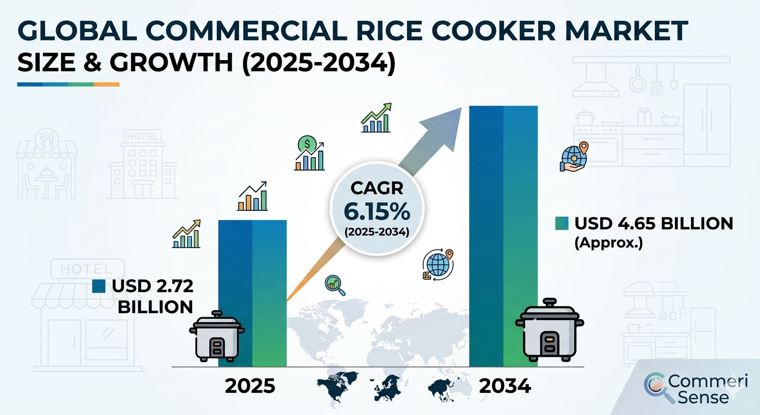
The global commercial rice cooker market size was USD 2.72 billion in 2025 to approximately USD 4.65 billion by 2034, expanding at a CAGR of 6.15% from 2025 to 2034.
The global commercial rice cooker market represents a specialized yet steadily expanding segment within the broader food service equipment industry. Commercial rice cookers are high-capacity cooking appliances designed to prepare large quantities of rice efficiently, consistently, and with minimal supervision. Unlike household rice cookers, these units are engineered for heavy-duty use in environments such as restaurants, hotels, catering services, institutional kitchens, hospitals, military bases, and large-scale cafeterias. Their primary value lies in delivering uniform cooking results while reducing labor dependency and operational time in high-demand food preparation settings.
In recent years, the market has witnessed consistent growth, driven by the rising global consumption of rice as a staple food, especially across Asia-Pacific, parts of Africa, and Latin America. As urbanization accelerates and food service industries expand, the demand for efficient bulk cooking solutions has increased significantly. This trend is particularly visible in densely populated countries where rice remains a dietary cornerstone. Commercial rice cookers help food businesses maintain quality and consistency while managing large volumes, making them indispensable in professional kitchens.
One of the key factors influencing the expansion of this market is the rapid growth of the hospitality and food service sector. Restaurants, fast-casual dining chains, and institutional catering services are increasingly adopting automated cooking equipment to improve operational efficiency. Commercial rice cookers allow chefs and kitchen staff to focus on other critical tasks while ensuring that rice is cooked to the desired texture and quality every time. This operational efficiency is particularly valuable in high-turnover establishments where speed and consistency directly affect customer satisfaction.
Technological advancements have also played a significant role in shaping the commercial rice cooker market. Modern units are now equipped with features such as programmable cooking modes, automatic keep-warm functions, fuzzy logic technology, and energy-efficient heating systems. These innovations enhance precision cooking, reduce energy consumption, and improve safety standards. Some advanced models also include digital control panels, timers, and multi-functional capabilities that allow them to cook different types of rice and grains. Such technological integration has made commercial rice cookers more versatile and appealing to a wider range of end users.
Another important driver of market growth is the increasing focus on hygiene and food safety standards. Commercial kitchens are required to maintain strict compliance with health regulations, and automated cooking equipment helps minimize human contact during food preparation. Stainless steel construction, non-stick inner pots, and easy-to-clean designs contribute to maintaining sanitary conditions. Additionally, consistent cooking temperatures reduce the risk of undercooked or overcooked rice, which is essential for maintaining food quality and safety.
The market is also influenced by evolving consumer preferences and globalization of cuisine. As Asian cuisine gains popularity worldwide, the demand for authentic rice-based dishes has increased across international food chains and restaurants. This cultural diffusion has encouraged food service providers in non-traditional markets to invest in commercial rice cookers to meet customer expectations. Moreover, the rise of delivery services and cloud kitchens has further strengthened the need for reliable bulk cooking equipment.
Despite strong growth prospects, the market faces certain challenges. High initial investment costs for advanced commercial rice cookers can be a barrier for small and medium-sized enterprises. Additionally, maintenance requirements and the need for proper training in operating advanced models may limit adoption in some regions. Price sensitivity in developing markets also influences purchasing decisions, often leading buyers to opt for lower-cost or basic models.
Regionally, Asia-Pacific dominates the global commercial rice cooker market due to its high rice consumption and dense population. Countries such as China, India, Japan, South Korea, and Indonesia are major contributors to demand. North America and Europe are also experiencing gradual growth, driven by multicultural food trends and the expansion of Asian restaurant chains. Meanwhile, emerging economies in Africa and Latin America are expected to present new opportunities as food service infrastructure develops.
The global commercial rice cooker market is positioned for sustained expansion, supported by rising food service demand, technological innovation, and changing dietary patterns. As efficiency, consistency, and automation continue to shape modern kitchen operations, commercial rice cookers are expected to remain a vital component of professional food preparation systems worldwide.
Key Commercial Rice Cooker Market Dynamics
The commercial rice cooker market is shaped by a complex set of interrelated dynamics, including demand-side growth drivers, technological advancements, cost structures, regulatory influences, and evolving end-user expectations. These dynamics collectively determine how the market expands, the pace of innovation, and the level of competition among manufacturers. Understanding these factors is essential for evaluating both current performance and future growth potential of the industry.
One of the most significant market dynamics is the rising demand from the global food service industry. Restaurants, hotels, catering businesses, and institutional kitchens are increasingly relying on high-capacity cooking equipment to meet growing customer volumes. As urban populations expand and lifestyles become faster-paced, more people depend on dining out, takeaway meals, and food delivery services. This shift directly increases the need for efficient kitchen equipment that can deliver large quantities of food in a consistent and time-saving manner. Commercial rice cookers, in particular, are essential in regions where rice is a staple food and forms a major component of daily meals.
Another key driver influencing the market is operational efficiency. Food service operators are under constant pressure to reduce preparation time, optimize labor usage, and maintain consistent food quality. Commercial rice cookers address these needs by automating the cooking process, minimizing manual supervision, and ensuring standardized output. Features such as automatic shut-off, temperature control, and keep-warm functions reduce the workload on kitchen staff while improving productivity. This efficiency is especially important in high-volume environments such as cafeterias, banquet halls, and institutional kitchens where large quantities of rice must be prepared regularly.
Technological innovation is also reshaping the market dynamics significantly. Modern commercial rice cookers are increasingly equipped with advanced features such as microcomputer-controlled cooking systems, fuzzy logic technology, induction heating, and multi-grain cooking capabilities. These innovations allow precise control over texture, moisture, and cooking time, resulting in better food quality. Energy-efficient designs are also gaining importance as businesses aim to reduce operational costs and meet sustainability goals. Manufacturers are investing in research and development to create smarter, more durable, and more versatile cooking appliances that cater to diverse culinary requirements.
Cost dynamics play a crucial role in shaping purchasing decisions within the market. Commercial rice cookers range from basic models to highly advanced systems, and pricing varies accordingly. While large enterprises and premium hospitality chains often invest in high-end models with advanced features, small and medium-sized food businesses tend to opt for more affordable solutions. The initial capital investment, along with maintenance and energy consumption costs, directly influences adoption rates. In price-sensitive regions, cost considerations may slow down the transition from traditional cooking methods to automated systems.
Supply chain and raw material availability also impact market behavior. Commercial rice cookers are primarily manufactured using stainless steel, aluminum, and electronic components, all of which are subject to global supply fluctuations. Any disruption in the supply chain, such as increased metal prices or semiconductor shortages, can affect production costs and product pricing. Manufacturers must therefore maintain flexible sourcing strategies and efficient production systems to remain competitive and meet market demand.
Regulatory and safety standards are another important dynamic in the commercial rice cooker market. Food safety regulations require kitchen equipment to meet strict hygiene and performance standards. This has led manufacturers to design products with easy-to-clean surfaces, food-grade materials, and enhanced safety mechanisms. Compliance with international certifications also helps companies expand into global markets. Additionally, energy efficiency regulations in several regions are pushing manufacturers to develop environmentally friendly and low-energy consumption models.
Consumer behavior and culinary globalization further influence market dynamics. The growing popularity of Asian cuisine across North America, Europe, and other regions has increased the demand for authentic rice-based dishes. As a result, restaurants and food chains are adopting commercial rice cookers to ensure consistency in taste and texture. The expansion of multicultural dining habits has broadened the customer base beyond traditional rice-consuming regions, contributing to global market growth.
Competition among manufacturers is another defining factor. The market is moderately fragmented, with both established kitchen equipment brands and regional manufacturers competing for market share. Companies differentiate themselves through product innovation, pricing strategies, durability, and after-sales service. Strong competition encourages continuous improvement in product quality and feature enhancement, benefiting end users.
The key dynamics of the commercial rice cooker market are driven by a combination of rising food service demand, technological progress, cost sensitivity, regulatory compliance, and changing consumer preferences. These forces collectively shape the market landscape, influencing how manufacturers innovate and how end users adopt new cooking technologies. As these dynamics continue to evolve, the market is expected to become more efficient, competitive, and technologically advanced in the coming years.
Key Commercial Rice Cooker Market Restraints
The commercial rice cooker market, while experiencing steady growth driven by rising demand from the food service industry, also faces several restraints that limit its expansion across different regions. These constraints are shaped by economic, operational, technological, and infrastructural challenges that affect both manufacturers and end users. Understanding these restraints is essential to gaining a balanced perspective on the market’s overall trajectory.
One of the primary restraints in the commercial rice cooker market is the high initial investment cost associated with advanced equipment. Commercial-grade rice cookers, especially those equipped with modern technologies such as induction heating, fuzzy logic control, and automated programming, tend to be significantly more expensive than basic models or traditional cooking methods. For small and medium-sized food service businesses, particularly in developing economies, this upfront cost can be a major barrier to adoption. Many smaller establishments continue to rely on conventional cooking techniques or low-cost alternatives, which slows down market penetration.
In addition to high purchase costs, maintenance and repair expenses also act as a limiting factor. Commercial rice cookers are used frequently in high-volume environments, which leads to wear and tear over time. Advanced models often require specialized servicing, replacement parts, and technical expertise for repairs. In regions where after-sales support is limited, downtime due to equipment failure can disrupt kitchen operations, discouraging businesses from investing in sophisticated models. This concern is particularly relevant for remote or rural areas where access to authorized service centers is limited.
Another significant restraint is the availability of substitutes and traditional cooking methods. In many parts of the world, especially in Asia and Africa, rice is still commonly prepared using conventional pots, steamers, or open-flame cooking methods. These traditional techniques are deeply rooted in cultural practices and are often perceived as more cost-effective for small-scale cooking. In such environments, the perceived necessity of commercial rice cookers is lower, especially among small eateries or household-based food businesses. This preference for traditional cooking methods restricts the adoption of automated rice cooking solutions.
Energy consumption is also a concern that impacts the growth of the commercial rice cooker market. Although modern models are designed to be more energy-efficient, large-capacity commercial units still consume a considerable amount of electricity during prolonged use. In regions where electricity costs are high or power supply is unstable, food service operators may hesitate to adopt electric cooking appliances. This is especially true in developing countries where infrastructure challenges such as frequent power outages or voltage fluctuations can affect equipment performance and reliability.
Technological complexity presents another restraint, particularly for small businesses with limited technical expertise. Advanced commercial rice cookers come with digital interfaces, programmable settings, and automated features that require proper training to operate effectively. Inadequate knowledge or improper usage can lead to inconsistent cooking results or equipment damage. As a result, some users prefer simpler, manually operated devices that are easier to manage, even if they lack advanced features and efficiency benefits.
Space limitations in commercial kitchens also restrict market growth. Many food service establishments, especially small restaurants and street food vendors, operate in compact kitchen environments where space optimization is critical. Large-capacity commercial rice cookers may occupy significant counter or floor space, making them less practical for such setups. This constraint often forces businesses to opt for smaller or multi-purpose equipment instead of dedicated rice cooking appliances.
Another restraint is the slow adoption rate in certain underdeveloped and rural markets. Limited awareness about the benefits of commercial rice cookers, combined with lower purchasing power, reduces demand in these regions. Additionally, fragmented distribution networks and lack of marketing outreach further hinder product penetration. Manufacturers often face difficulties in expanding their presence in such markets due to logistical and economic challenges.
Fluctuations in raw material prices also indirectly affect the market. The production of commercial rice cookers depends on materials such as stainless steel, aluminum, and electronic components. Volatility in global supply chains and raw material costs can lead to increased product prices, which may discourage potential buyers. This pricing instability can also affect manufacturers’ profit margins and limit their ability to offer competitive pricing.
Commercial Rice Cooker Market Opportunities
The commercial rice cooker market presents a wide range of growth opportunities driven by evolving consumer lifestyles, rapid expansion of the food service industry, technological advancements, and increasing demand for efficient kitchen automation. As global dietary patterns continue to diversify and food consumption shifts toward convenience and consistency, commercial rice cookers are becoming essential equipment in both traditional and modern culinary environments. These emerging opportunities are expected to significantly shape the future growth trajectory of the market.
One of the most prominent opportunities lies in the rapid expansion of the global food service industry. Restaurants, hotels, catering companies, and institutional kitchens are scaling their operations to meet increasing consumer demand. With rising urbanization and busy lifestyles, more people are dining out or ordering food through delivery platforms. This trend creates a strong need for high-capacity, efficient cooking equipment that can ensure consistent food quality at scale. Commercial rice cookers, which reduce manual effort while delivering uniform results, are well-positioned to benefit from this expanding sector.
The growing popularity of Asian cuisine across the globe also presents a significant opportunity for market growth. Dishes based on rice are becoming increasingly common in North America, Europe, and other non-traditional markets. Sushi, biryani, fried rice, and rice bowls have gained widespread acceptance among global consumers. As a result, restaurants and food chains outside Asia are increasingly investing in commercial rice cookers to maintain authenticity and consistency in their offerings. This globalization of culinary preferences is expected to continue driving demand for specialized rice cooking equipment.
Technological innovation is another key area of opportunity in the commercial rice cooker market. Manufacturers are developing advanced models equipped with features such as fuzzy logic control, induction heating, programmable cooking modes, and smart sensors. These technologies enhance cooking precision, reduce energy consumption, and improve operational efficiency. The integration of IoT (Internet of Things) and smart kitchen technologies presents a future opportunity where rice cookers can be remotely monitored and controlled, enabling better kitchen management and predictive maintenance. Such innovations are likely to attract high-end commercial users seeking automation and efficiency.
Energy efficiency and sustainability trends also offer strong growth prospects. With increasing global focus on environmental responsibility and rising energy costs, food service businesses are actively seeking energy-saving appliances. Modern commercial rice cookers that consume less power while maintaining performance are gaining traction. Manufacturers who invest in eco-friendly designs, recyclable materials, and low-energy heating systems are likely to gain a competitive advantage. Governments in several regions are also encouraging energy-efficient appliances through regulations and incentives, further supporting this opportunity.
The expansion of cloud kitchens and delivery-only restaurant models represents another major opportunity for the market. Cloud kitchens operate with a focus on high-volume food production and minimal dine-in services, making efficiency and speed critical. Commercial rice cookers are highly suitable for such setups due to their ability to prepare large quantities of rice quickly and consistently. As the cloud kitchen industry continues to grow globally, particularly in urban centers, demand for reliable and scalable cooking equipment is expected to rise significantly.
Emerging economies present substantial untapped opportunities for market expansion. Countries in Asia-Pacific, Africa, and Latin America are witnessing improvements in infrastructure, rising disposable incomes, and increasing urbanization. As food service sectors in these regions modernize, the demand for commercial kitchen equipment is expected to grow. Small and medium-sized restaurants, hotels, and catering businesses in these regions are gradually shifting from traditional cooking methods to automated solutions, creating a large potential customer base for commercial rice cooker manufacturers.
Product diversification is also opening new avenues for growth. Manufacturers are increasingly introducing multi-functional rice cookers that can prepare not only rice but also grains, porridge, soups, and steamed dishes. This versatility increases the utility of the equipment in commercial kitchens where space and efficiency are critical. Additionally, compact and modular designs are being developed to cater to smaller food establishments, expanding the market reach to a broader range of users.
After-sales service, customization, and branding opportunities are further enhancing market potential. Companies that offer strong technical support, maintenance services, and customized solutions for specific kitchen requirements are likely to build stronger customer loyalty. Additionally, partnerships with hospitality chains, institutional buyers, and food service franchises provide opportunities for long-term contracts and bulk sales.
Commercial Rice Cooker Market Drivers
The commercial rice cooker market is experiencing steady expansion due to a combination of structural, economic, and technological drivers that are reshaping the global food service industry. These drivers are closely linked to changing consumption patterns, rising demand for convenience, and the increasing need for efficiency in professional kitchens. As food businesses scale operations to serve larger customer bases, commercial rice cookers are becoming essential equipment for ensuring speed, consistency, and quality in large-volume food preparation.
One of the most influential drivers is the rapid growth of the global food service industry. Restaurants, hotels, catering services, and institutional kitchens are expanding in both developed and developing regions due to rising urbanization and increasing disposable incomes. As more consumers dine out or rely on prepared meals, food service providers are under pressure to deliver high-quality dishes in large quantities within short timeframes. Commercial rice cookers help meet this demand by enabling bulk cooking with minimal supervision, making them a vital asset in high-volume kitchen operations.
Closely related to this is the increasing global consumption of rice as a staple food. Rice is a primary dietary component for a large portion of the world’s population, particularly in Asia-Pacific regions such as India, China, Indonesia, and Japan. However, its popularity is also growing in Western countries due to globalization and the rising popularity of international cuisines such as sushi, biryani, and rice bowls. This widespread consumption creates a consistent and large-scale demand for efficient rice preparation equipment, thereby driving adoption of commercial rice cookers across diverse markets.
Another key driver is the rising demand for operational efficiency and labor optimization in commercial kitchens. Food service businesses are continuously looking for ways to reduce preparation time, minimize labor costs, and improve workflow efficiency. Commercial rice cookers automate the cooking process, allowing kitchen staff to focus on other tasks such as preparation of side dishes and customer service. Features such as automatic shut-off, keep-warm functions, and programmable settings reduce manual intervention while ensuring consistent output. This operational efficiency is particularly valuable in environments such as cafeterias, hotels, and catering services where large quantities of rice must be prepared regularly.
Technological advancements are also significantly driving market growth. Modern commercial rice cookers are equipped with advanced features such as fuzzy logic technology, induction heating, microcomputer-based controls, and multi-cooking functions. These innovations enhance cooking precision, allowing better control over texture, moisture, and temperature. Energy-efficient models are also gaining traction as businesses aim to reduce electricity consumption and operational costs. The integration of smart features and digital interfaces has further improved usability, making these devices more attractive to modern commercial kitchens.
The expansion of quick-service restaurants (QSRs) and fast-casual dining chains is another important driver. These food service models rely heavily on speed, consistency, and standardized food preparation processes. Commercial rice cookers enable QSRs to maintain uniform quality across multiple outlets while handling high order volumes efficiently. As global fast-food chains expand into emerging markets, the demand for standardized kitchen equipment, including rice cookers, continues to rise.
Urbanization and changing lifestyles also contribute significantly to market growth. As urban populations grow, consumers increasingly rely on ready-to-eat meals, takeaway services, and food delivery platforms. This shift has led to the rapid expansion of centralized kitchens and cloud kitchen models, which depend on high-efficiency cooking equipment. Commercial rice cookers play a critical role in these setups by supporting bulk production with minimal human intervention, ensuring speed and consistency in food delivery operations.
Additionally, rising investments in the hospitality and tourism industry are fueling demand for commercial kitchen equipment. Hotels, resorts, and catering companies require large-scale cooking solutions to serve diverse customer groups efficiently. As global tourism continues to recover and expand, especially in developing economies, the need for reliable and durable cooking equipment is increasing, further driving the adoption of commercial rice cookers.
Hygiene and food safety requirements are also acting as strong market drivers. Regulatory standards across many countries require commercial kitchens to maintain strict hygiene protocols. Commercial rice cookers, typically made from stainless steel and designed for easy cleaning, help reduce contamination risks and ensure consistent cooking temperatures. This makes them an attractive solution for businesses aiming to comply with food safety regulations while maintaining operational efficiency.
The commercial rice cooker market is being driven by a strong combination of factors, including the expansion of the food service industry, rising global rice consumption, technological innovation, and increasing demand for operational efficiency. Additional support comes from the growth of QSRs, urbanization trends, and stringent hygiene standards. Together, these drivers are creating a favorable environment for sustained market growth and continued adoption of commercial rice cooking solutions worldwide.
Commercial Rice Cooker Market Trends
The commercial rice cooker market is evolving rapidly as food service businesses adopt more efficient, automated, and technology-driven kitchen solutions. Several key trends are shaping the industry, influenced by changing consumer preferences, modernization of commercial kitchens, and the global expansion of the hospitality sector. These trends highlight how manufacturers are innovating to meet rising demand for convenience, consistency, and sustainability in large-scale food preparation.
One of the most prominent trends is the increasing adoption of smart and automated cooking technologies. Modern commercial rice cookers are now equipped with microcomputer-controlled systems, fuzzy logic, and sensor-based temperature regulation. These features allow the appliance to automatically adjust cooking time, heat levels, and moisture content to produce consistently high-quality rice. Some advanced models are also integrating digital displays and programmable menus, enabling chefs to customize cooking processes based on different rice varieties and recipes. This shift toward automation is helping reduce human intervention and improve kitchen efficiency.
Another major trend is the growing focus on energy efficiency and sustainability. With rising energy costs and increasing environmental awareness, food service operators are prioritizing appliances that consume less power while maintaining performance. Manufacturers are responding by developing induction heating systems and improved insulation technologies that reduce energy loss. Eco-friendly materials and recyclable components are also being used more frequently in product design. This trend aligns with global sustainability goals and regulatory pressures encouraging energy-efficient commercial appliances.
The expansion of cloud kitchens and delivery-based food services is also significantly influencing market trends. Cloud kitchens operate on a high-volume production model, focusing on speed, consistency, and cost efficiency. Commercial rice cookers are increasingly being used in these setups due to their ability to handle bulk cooking with minimal supervision. As online food delivery platforms continue to grow globally, the demand for reliable and scalable kitchen equipment is rising, further strengthening the role of commercial rice cookers in modern food production systems.
Product diversification is another notable trend in the market. Manufacturers are introducing multi-functional rice cookers that can prepare a variety of dishes beyond rice, such as porridge, soups, grains, and steamed foods. This versatility is particularly valuable in commercial kitchens where space is limited and efficiency is critical. Compact and portable models are also gaining popularity among small restaurants, food trucks, and catering businesses. These innovations are helping expand the customer base across different segments of the food service industry.
There is also a rising trend of digitalization and IoT integration in commercial kitchen equipment. Some advanced rice cookers now offer connectivity features that allow remote monitoring, performance tracking, and predictive maintenance. This helps restaurant operators manage kitchen operations more effectively and reduce downtime caused by equipment failure. As smart kitchen ecosystems become more common, such digital integration is expected to play a larger role in future product development.
In addition, increasing demand for hygiene and safety-focused designs is shaping product trends. Stainless steel construction, non-stick inner pots, and easy-to-clean surfaces are becoming standard features in modern commercial rice cookers. These designs help ensure compliance with strict food safety regulations while reducing cleaning time and effort in busy commercial kitchens.
The commercial rice cooker market is being shaped by key trends such as automation, energy efficiency, cloud kitchen expansion, product diversification, digital integration, and improved hygiene standards. These evolving trends reflect the industry’s shift toward smarter, more efficient, and more sustainable cooking solutions, positioning commercial rice cookers as an essential component of modern food service operations.
Leading Key Players in the Commercial Rice Cooker Market
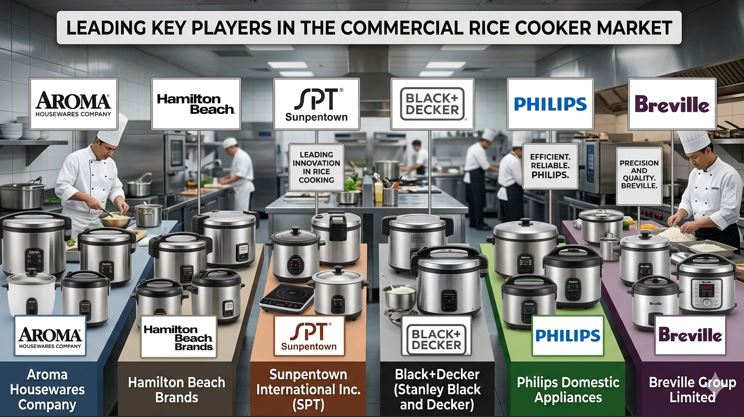
- Aroma Housewares Company
- Hamilton Beach Brands
- Sunpentown International Inc. (SPT)
- Black+Decker (Stanley Black and Decker)
- Philips Domestic Appliances
- Breville Group Limited
- Electrolux AB
- Sharp Corporation
- Conair Corporation (Cuisinart)
- Joyoung Co. Ltd.
- Midea Group
Commercial Rice Cooker Market Segmentation
The commercial rice cooker market is segmented based on type, application, and capacity to better understand demand patterns across different end-use environments. This segmentation highlights how varying operational requirements, kitchen sizes, and consumption volumes influence purchasing decisions. As food service businesses continue to diversify globally, each segment of the market is evolving with unique growth dynamics and adoption trends.
By Type Analysis
Commercial rice cookers are primarily categorized into electric rice cookers, gas rice cookers, induction heating rice cookers, and conventional automatic rice cookers. Among these, electric rice cookers dominate the market due to their ease of use, wide availability, and suitability for most commercial kitchen environments. These cookers are widely used in restaurants, hotels, and institutional cafeterias because they offer consistent performance, automated cooking cycles, and minimal supervision requirements. Their ability to maintain uniform cooking results makes them highly preferred in high-volume operations.
Induction heating rice cookers represent a rapidly growing segment due to their superior energy efficiency and precise temperature control. Unlike conventional heating methods, induction technology distributes heat more evenly, resulting in better texture and improved cooking consistency. These models are increasingly adopted in premium hotels and high-end restaurants where quality and precision are critical. Although they come at a higher cost, their long-term energy savings and performance advantages are driving adoption in modern commercial kitchens.
Gas rice cookers, on the other hand, are widely used in regions where gas is more economical or where electricity supply is unreliable. These cookers are particularly popular in developing economies and large-scale catering operations where cost efficiency is a priority. They provide strong heating capabilities and are suitable for cooking large quantities of rice quickly. However, they require manual monitoring compared to electric and induction models, which limits their adoption in automated kitchen environments.
Conventional automatic rice cookers continue to hold a steady share in small to mid-sized food establishments. While they may lack advanced features, their affordability and simplicity make them attractive for budget-conscious users. These cookers are commonly used in local restaurants, small cafeterias, and food stalls where operational complexity must be minimized.
By Application Analysis
The application segment of the commercial rice cooker market includes restaurants, hotels, catering services, institutional kitchens, and others such as food trucks and cloud kitchens. Restaurants account for the largest share of the market due to their consistent demand for rice-based dishes and high customer turnover. Fast-casual dining outlets and Asian cuisine restaurants, in particular, rely heavily on commercial rice cookers to maintain consistency and speed in food preparation.
Hotels represent another significant application segment, as they require large-scale cooking equipment to serve diverse meals across breakfast, lunch, and dinner services. Banquet halls and luxury hospitality chains often use high-capacity rice cookers to cater to large events and buffets. Consistency and efficiency are key factors driving adoption in this segment.
Catering services also contribute significantly to market demand. These businesses require portable and high-capacity cooking equipment that can serve large groups at events such as weddings, corporate functions, and public gatherings. Commercial rice cookers enable caterers to prepare bulk quantities of rice efficiently while maintaining quality and temperature for extended periods.
Institutional kitchens, including schools, hospitals, military bases, and corporate cafeterias, form another important application segment. These facilities require reliable, durable, and easy-to-operate equipment capable of handling large-scale meal production daily. Consistency, hygiene, and cost-effectiveness are key priorities in this segment, making commercial rice cookers an essential asset.
Emerging applications such as cloud kitchens and food trucks are also gaining traction. These modern food service models rely heavily on compact, efficient, and high-output cooking equipment to meet delivery-driven demand. Commercial rice cookers are increasingly being integrated into these setups due to their efficiency and scalability.
Geographical Analysis of Commercial Rice Cooker Market
The global commercial rice cooker market exhibits strong regional variation, driven by differences in dietary habits, economic development, and food service infrastructure. Asia-Pacific dominates the market due to its high rice consumption and deeply rooted culinary traditions. Countries such as China, India, Japan, South Korea, and Indonesia are major contributors, with rice being a staple food in daily diets. The large population base and rapid expansion of the food service sector further strengthen regional demand.
North America is witnessing steady growth, driven by the increasing popularity of Asian cuisine and the expansion of restaurant chains specializing in rice-based dishes. The rise of multicultural dining trends and fast-casual restaurants has boosted the adoption of commercial rice cookers in commercial kitchens across the region.
Europe is also experiencing moderate growth, supported by the rising demand for ethnic cuisine and expanding hospitality sectors in countries such as the United Kingdom, Germany, and France. Food service providers are increasingly adopting advanced kitchen equipment to improve efficiency and maintain consistency in diverse culinary offerings.
Latin America and the Middle East & Africa regions are emerging markets with significant growth potential. Rising urbanization, increasing disposable incomes, and the gradual modernization of food service infrastructure are driving demand for commercial kitchen equipment. Although adoption rates are still developing, these regions are expected to offer long-term growth opportunities as awareness and accessibility improve.
FAQ
1. What is a commercial rice cooker used for?
A commercial rice cooker is used in restaurants, hotels, catering services, and institutional kitchens to cook large quantities of rice efficiently. It ensures consistent texture, saves cooking time, and reduces manual effort in high-volume food preparation environments.
2. What are the main types of commercial rice cookers available in the market?
The main types include electric rice cookers, induction heating rice cookers, gas rice cookers, and conventional automatic rice cookers. Each type is designed for different operational needs, ranging from small food outlets to large-scale commercial kitchens.
3. Which industries use commercial rice cookers the most?
Commercial rice cookers are widely used in the hospitality industry, restaurants, catering businesses, hotels, and institutional kitchens such as schools, hospitals, and corporate cafeterias. Cloud kitchens and food delivery services are also emerging users.
4. What are the key benefits of using a commercial rice cooker?
The key benefits include consistent cooking quality, high efficiency, reduced labor dependency, time savings, and the ability to cook large quantities of rice at once. Many modern models also offer energy efficiency and automated cooking features.
5. What factors are driving the growth of the commercial rice cooker market?
The market is driven by the expansion of the food service industry, increasing rice consumption globally, rising demand for automation in kitchens, technological advancements, and the growing popularity of Asian cuisine worldwide.
https://www.zerogpt.com/ai-humanizer
Gemini ai – -Create Image –
Tiny png for small size image
